

You probably knew your tax bill was high. You may not have known exactly how high — or how far outside the norm it actually sits.
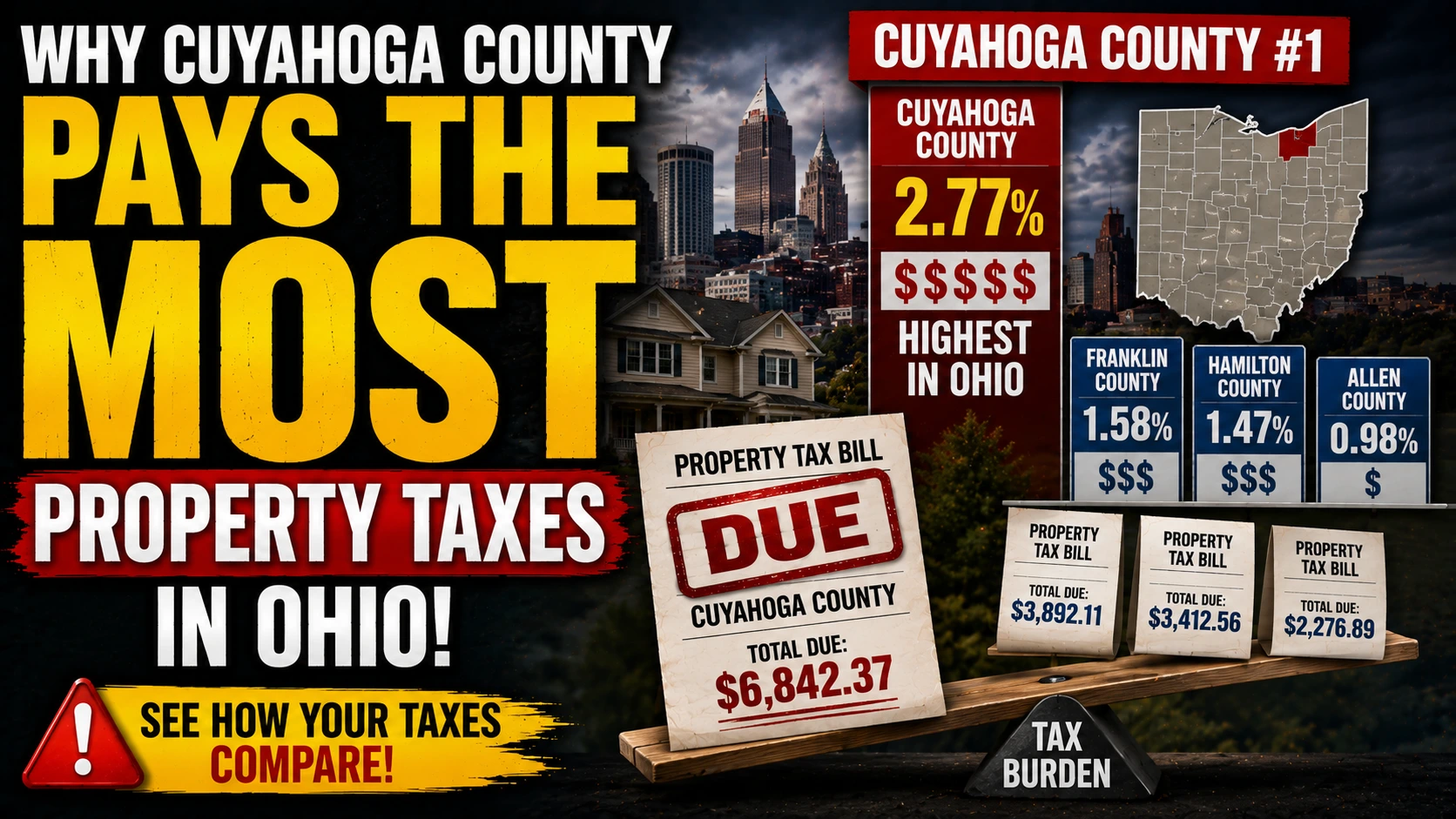
Cuyahoga County’s effective property tax rate is 1.89%, the highest of all 88 counties in Ohio. That single number has real consequences. For the median homeowner here, it translates to roughly $3,910 per year — about $326 every month — on a home valued at $195,400. And for anyone sitting in a higher-value community, or anyone whose home was recently reappraised, that number is already climbing.
The uncomfortable part? Most homeowners in this county have no idea why the rate is so high, whether it’s likely to change, or what — if anything — they can do about it.
Ohio’s #1 County. By a Wide Margin.
Ohio’s largest county by population also carries the highest property taxes in the state. That’s not a coincidence. Size, history, and a particular structure of local government financing all converge here in ways that push the rate above every other county in Ohio.
Cuyahoga County’s effective rate of 1.89% sits 0.53% above the Ohio average — and 1.06% above the U.S. average. That gap doesn’t sound dramatic until you run the math on a real home.
Consider a $300,000 property. At Cuyahoga County’s effective rate, the annual tax bill comes to approximately $5,670 — roughly $473 per month. Now consider the Ohio average rate of 1.36%. On that same home, the bill would be closer to $4,080. On a $400,000 home, the difference between Cuyahoga’s rate and the Ohio average amounts to roughly $2,120 per year — a gap that compounds to approximately $21,200 over a decade of homeownership.
That’s the financial cost of living in this county versus nearly anywhere else in the state.
The Real Reason: It’s the Schools
Here’s the part that surprises most people: the county government itself isn’t why your bill is so high. School district levies are the largest component of Ohio property tax bills — which is why the same property in adjacent school districts can carry meaningfully different tax obligations.
In Lakewood, for instance, the school district received approximately 54 percent of total property tax collections as of 2023, with the city receiving about 21 percent, the library receiving roughly 1.85 percent, and Cuyahoga County itself receiving approximately 23 percent.
Cuyahoga County contains 33 separate school districts. Each one has its own levy history — its own set of voter-approved millage rates stacked on top of each other over decades. Some of those districts, particularly the inner-ring suburbs, have approved multiple levies over the years to fund school operations without adequate state support. That history accumulates. It doesn’t disappear when the levy renews.
Within Cuyahoga County, the highest effective rate is found in Bedford Heights at 3.45%, while Strongsville has the lowest at 1.64%. These variations reflect differences in local school district levies, special assessment districts, and special district bonds — which compound the base county rate.
That spread — from 1.64% to 3.45% — tells you almost everything. Two homes sitting 20 miles apart in the same county can carry wildly different annual tax obligations, and most of that difference traces back to what school levies voters approved in those communities, sometimes 30 or 40 years ago.
What the 2024 Reappraisal Did to the Math
For years, the conversation about Cuyahoga County property taxes was abstract for many homeowners. Then 2024 happened.
In 2024, Cuyahoga County completed its latest round of property reappraisals. On average, home values increased 32 percent. In some neighborhoods, the jump was far steeper. Countywide, the increases ranged from 15 percent in Hunting Valley to 67 percent in East Cleveland.
Ohio law does provide some protection through House Bill 920, passed in 1976. If your home’s value increases by 30 percent, your tax bill on voted levies will not increase by the same amount. The law adjusts the effective rate downward to offset the impact of reappraisals. But that protection has limits. It does not apply to new levies or unvoted inside millage.
Here’s what that means in practice. A homeowner in a Cleveland suburb who purchased their home in 2019 for $175,000 could easily find their property reappraised at $230,000 following the 2024 cycle. Their assessed value would jump from $61,250 to $80,500. At a modest effective rate, that shift alone could add $300 to $500 to their annual tax obligation.
And for longtime residents in neighborhoods that appreciated sharply? The math gets harder. Consider a homeowner in East Cleveland whose property was assessed at $45,000 in the prior cycle. After the 2024 reappraisal, at a 67 percent increase, that assessed value climbs to roughly $75,000 — and at the effective millage rates common in that taxing district, the annual bill difference can run several hundred dollars per year.
The Counterintuitive Truth About Ohio’s System
Here is something most people don’t know, and it matters: Ohio doesn’t tax you on what your home is worth.
Ohio property taxes are based on the assessed value — set at 35 percent of the county’s estimated market value — multiplied against the millage rate for your specific taxing district. So if your home is appraised at $200,000, you’re taxed on $70,000 — not the full amount.
That sounds like relief. And it is, compared to states that tax the full market value. But it also creates confusion. Homeowners see their assessed value and don’t understand why it doesn’t match what their neighbor just sold for. Or they see the county’s appraised market value and assume that’s the number driving their bill.
It isn’t. And when you don’t understand the formula, you can’t challenge it effectively.
According to the Cuyahoga County Budget Commission, more than $3.8 billion in property tax revenue is distributed annually to 38 cities, 19 villages, 2 townships, 33 school districts, 9 library systems, and 4 county taxing authorities — including Cleveland Metroparks. That system depends on homeowners paying their bills. And most do. But the strain is becoming visible.
As of December 10, 2025, Cuyahoga County was owed more than $248 million in delinquent property taxes across roughly 25,000 parcels. That’s not an abstraction. It’s a signal that rising assessments have pushed some households past what they can absorb.
How Cuyahoga Compares to the Rest of Ohio — and the Nation
For context, here’s where Cuyahoga stands relative to the state and country:
Cuyahoga County’s median effective rate of 2.27% is significantly higher than the national median of 1.02%. The county’s median annual tax bill is $4,087, which is $1,687 higher than the national median property tax bill.
According to the Tax Foundation, Ohio has the eighth-highest effective property tax rate in the country. Cuyahoga County sits at the top of that already-high-ranking state. Residents here aren’t just paying more than their Ohio neighbors — they’re paying more than homeowners in nearly every other county in one of the most heavily taxed states in the country.
Franklin County (Columbus) has an effective rate around 1.40%. Hamilton County (Cincinnati) comes in at 1.44%. The average property tax rate in the United States as a whole is around 1.10%. Cuyahoga County’s rate is more than double that.
What Homeowners Here Can Actually Do
Knowing why the rate is high doesn’t lower your bill. But knowing your options might.
First, verify your assessed value. The Cuyahoga County Fiscal Hub at cuyahogacounty.gov lets you search by address or parcel number. Your current assessed value, tax history, and parcel details are publicly available at no cost. If your number looks wrong relative to what comparable homes are actually selling for in your neighborhood, that gap is the foundation of a formal appeal.
Second, check the exemptions you qualify for. The Homestead Exemption allows qualifying senior citizens age 65 and older and permanently disabled homeowners to shield up to $25,000 of their home’s market value from property taxation. For the current 2026 application period, that exempt value has increased to $29,000, with an income threshold of $41,000. Social Security income does not count toward that threshold — a fact many eligible residents do not know.
The Owner-Occupancy Credit reduces any homeowner’s bill by 2.5% if the property is a primary residence. It requires an application — and it doesn’t apply automatically in every situation, particularly after a property transfer.
Third, understand the appeal window. Homeowners who missed the March 31, 2026 deadline to challenge their assessed value cannot file again until January 2027. That next window — January 1 through March 31, 2027 — is the opportunity for anyone who believes their current valuation is inaccurate. Filing is free. It doesn’t require an attorney. And the Board of Revision does reduce values when the evidence supports it.
The Bottom Line
Cuyahoga County homeowners pay the highest effective property tax rate in Ohio — a distinction driven by decades of school levy accumulation, a fragmented local government structure, and a 2024 reappraisal that pushed assessed values sharply upward across much of the county.
The rate isn’t going to change because of any single policy decision. But your individual bill might — if you know what to look for and when to act.
Your assessed value is public information. Your exemption eligibility is worth checking. And the next appeal window is eight months away.
Most homeowners who overpay do so because they never questioned the number on the bill. That’s not a requirement.