

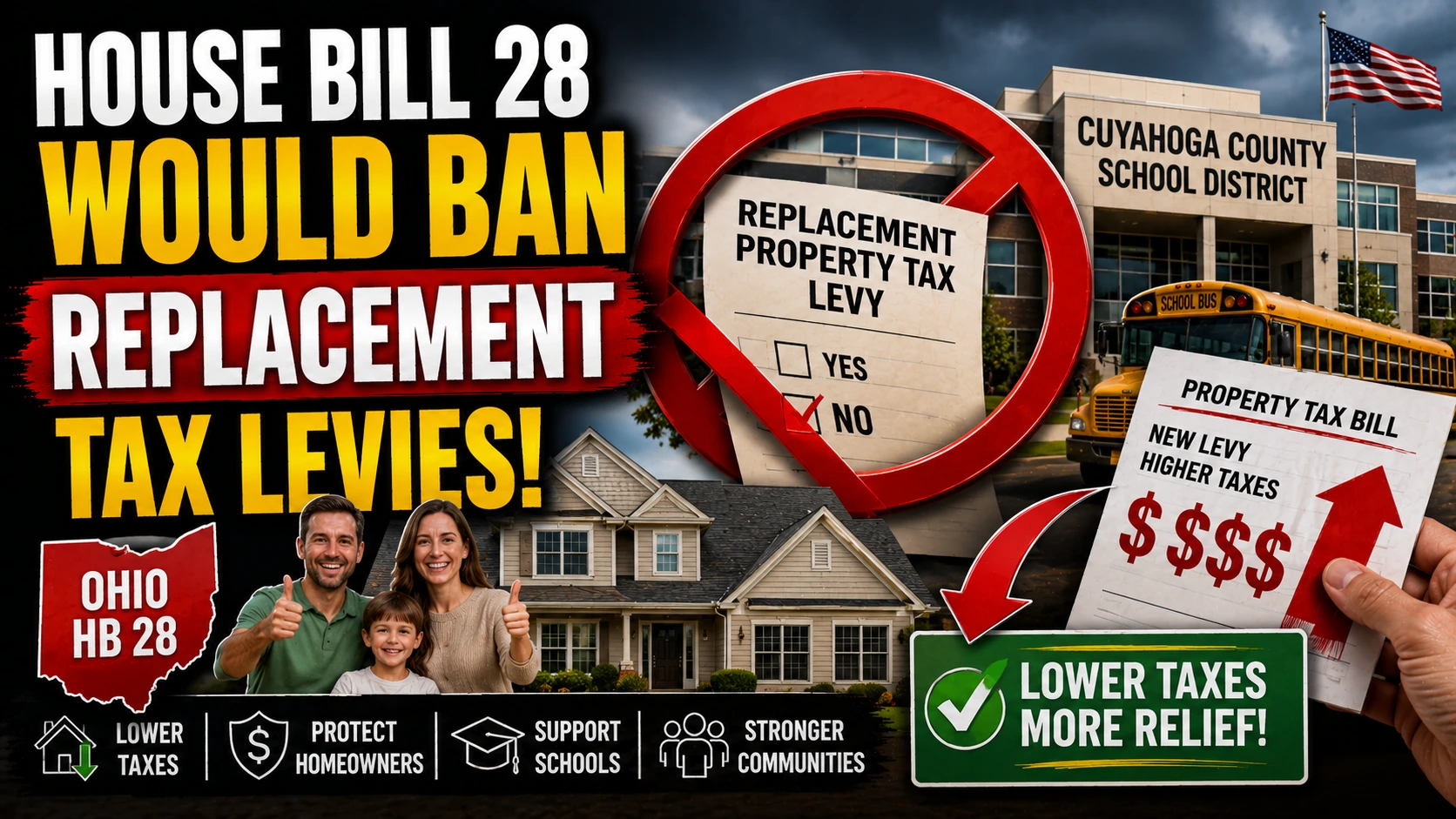
The levy on your property tax bill labeled “emergency” or “replacement” may not mean what you think it means. And because of a seismic shift in Ohio law — one that flew under the radar for most Cuyahoga County homeowners — the school districts and local governments that relied on those levy types to fund their budgets are now playing by a very different set of rules.
House Bill 28 would eliminate the authority to levy replacement property tax levies in Ohio. The bill passed the Ohio House 62-30 in March 2025 and sits in the Senate Ways and Means Committee as of this writing. But here’s what most coverage of HB 28 missed: the core policy it proposes was effectively enacted months before the bill ever gets a Senate vote. The General Assembly restored the ban on future substitute emergency levies and replacement levies by passing a veto override in October 2025. That override — of Item 66 from the state budget — put the replacement levy ban into effect for elections held on or after January 1, 2026.
For Cuyahoga County homeowners carrying a median tax bill of roughly $3,800 to $4,000 per year, this isn’t abstract legislative trivia. It reshapes how every school district, township, and municipality in the county can legally ask you for more money going forward.
What a replacement levy actually does to your tax bill
Most voters assume a levy renewal is a levy renewal — that saying “yes” on a ballot measure keeps taxes flat. That assumption is wrong, and it’s the precise confusion the replacement levy ban is designed to fix.
A renewal levy collects the exact amount of tax dollars as the levy it replaces. A replacement levy is different: it enables taxing authorities to receive taxes based on the current valuation of all property in an area, including new development. That distinction is enormous in a county that just went through a 2024 sexennial reappraisal with an average property value increase of 32.22% countywide — and in communities like East Cleveland, where assessed values jumped roughly 67%.
Here’s how the math works against you. Say a school district originally passed a 5-mill levy when your home was valued at $200,000. Under House Bill 920 — Ohio’s 1976 property tax freeze law — the effective rate adjusts downward over time so the levy collects roughly the same dollars. When that levy expires and the district puts a replacement levy on the ballot at the original 5 mills, it’s now calculating against your home’s newly assessed value. Your bill goes up. The district calls it a renewal. A replacement levy is a renewal of a levy that is set to expire, but it does mean property owners will be paying tax at a new rate, based on the current valuation of their property when the levy passes.
House Bill 28 sponsors argued these levies can mislead voters and result in unexpected property tax increases. When you vote yes on something labeled a “replacement,” many voters read that as maintaining the status quo. It isn’t.
How the ban works — and what it does not eliminate
Effective January 1, 2026, Ohio school districts and other local taxing authorities can no longer place replacement levy types on voter ballots. The reform does not affect existing levies of these types that are currently in place or those appearing on the November 2025 ballot.
What remains available going forward: renewal levies and new levies. The legislation preserves the ability of local governments to renew existing levies and propose increases or new levies directly. That sounds fine until you understand the approval rate difference. Voters approve renewals about 90% of the time, while they vote for new levies about 40% of the time.
That gap is the real consequence of this law. School districts that once finessed an expiring emergency levy into a voter-friendly “replacement” package now have to go back to voters with a straight new levy — a fundamentally harder ask, especially in a climate where Cuyahoga voters are already processing 32% average valuation increases from the 2024 reappraisal.
What this means for Cuyahoga school districts specifically
Thirty-two school districts operate within Cuyahoga County. Their fiscal situations vary dramatically — from the Cleveland Metropolitan School District serving the county’s largest city to smaller suburban districts like Olmsted Falls or Chagrin Falls with very different levy histories and property tax bases.
The ban hits hardest on districts that had built their long-term financial planning around the replacement levy structure. When districts need to ask voters for more money, they have often opted to renew an old levy and ask for an increase at the same time, because this strategy keeps the tax breaks for homeowners and gives the district additional cash. That option is now off the table for any levy going to ballot after January 1, 2026.
There’s a meaningful connection here to the HB 186 inflation cap credit that’s already appearing on 2026 second-half property tax bills — due August 13, 2026. That credit limits how much school districts at the 20-mill floor can collect when property values rise above the inflation rate. Districts squeezed by HB 186 are also the districts most likely to reach for new levies to fill the gap. They now face that voter test without the replacement levy tool in their kit.
Several Northeast Ohio school districts have already said their financial outlooks looked dire if voters did not approve their levy requests, and many have already had to submit budget reduction plans to the state. The May 2026 levy results were brutal: in a big test of voters’ appetite for income taxes versus property taxes, Northeast Ohio voters largely rejected school income tax levies, with apparently only one of 11 requests for new income taxes approved.
The trade-off you’re actually living inside
If you’re a Cuyahoga homeowner, the replacement levy ban cuts two ways.
On one hand, you now have more accurate information at the ballot box. When a district puts a new levy in front of you, the ballot language will clearly reflect that it’s new money — not a recycled emergency levy dressed up in replacement clothes. Sponsors argued the bill puts the power over property taxes where it belongs: with the voter and the homeowner.
On the other hand, if the school district serving your neighborhood can’t get a new levy passed — at a 40% approval rate rather than 90% — the financial pressure falls back on the district in the form of cuts. Teacher layoffs, reduced programming, deferred maintenance. Those cuts have real consequences for your property value and your community.
The reforms may result in more frequent levy campaigns as districts lose flexibility in structuring requests, which could increase campaign costs and voter fatigue while potentially reducing approval rates for necessary school funding.
The legislature’s argument is that transparency serves taxpayers better than a system where “replacement” is a term of art that obscures a tax increase. That argument has merit. But it doesn’t resolve the tension between keeping your tax bill predictable and keeping the schools your property value depends on adequately funded.
What HB 28 still has left to do in Columbus
The standalone House Bill 28 hasn’t been signed into law — it remains in the Senate Ways and Means Committee. The bill would amend sections 319.301, 319.302, and over a dozen other sections of the Revised Code, and repeal section 5705.192, to formally eliminate the replacement levy authority in Ohio statute. That codification matters even though the policy is already operative through the veto override, because a future legislature could theoretically revisit the override through a different mechanism. HB 28 would lock the ban into permanent statute.
Watch for Senate committee movement on this bill through the end of 2026. The 136th General Assembly’s session runs through December 31, 2026, and multiple property tax bills remain in play simultaneously — including HB 309, HB 335, and the ongoing debate over veto items 55, 63, and 65, which cover county budget commission authority, school district carryover limits, and how the 20-mill floor is calculated.
The next Board of Revision filing window opens January 1, 2027, for Tax Year 2025 valuations. If your assessment from the 2024 reappraisal still feels wrong, that’s your window to challenge it.