

Imagine opening your mailbox next January to find your property tax bill is zero.
For most Cuyahoga County homeowners — especially those staring down bills inflated by the 2024 reappraisal — that sounds like relief. It sounds like justice. After years of watching assessed values climb 32 percent, 59 percent, even 67 percent in some communities, the idea of abolishing property taxes entirely carries obvious emotional appeal.
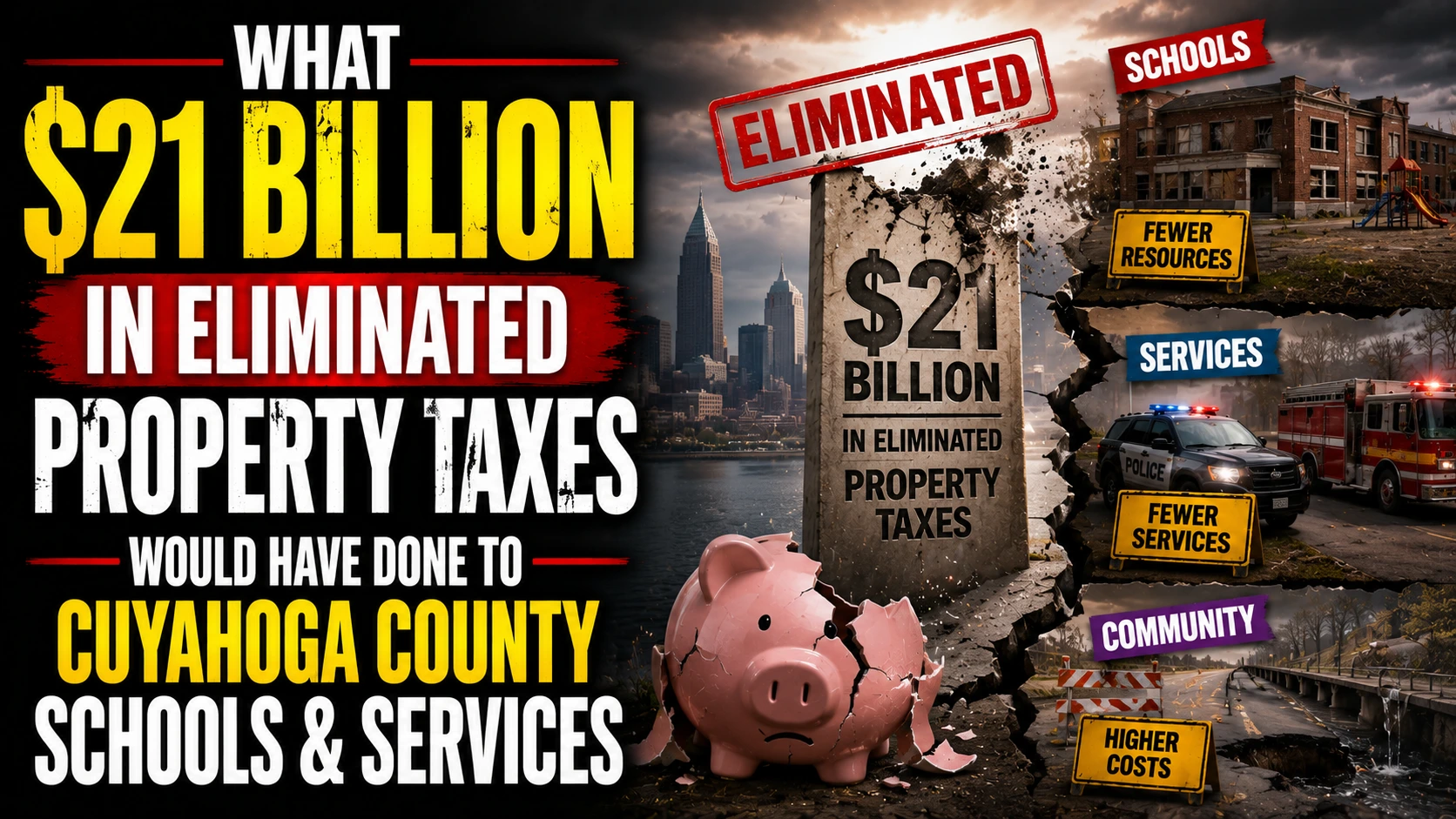
But before you celebrate, here is the question nobody asking for your signature has answered clearly: where does the $21 billion go?
Because it has to go somewhere.
The Number That Should Stop Everyone Cold
Eliminating property taxes in Ohio would wipe out approximately $21.4 billion in annual revenue — a figure nearly equal to the combined total of the state’s sales and income taxes. That is not a rounding error. That is the financial foundation of nearly every public institution Cuyahoga County residents use.
In Cuyahoga County specifically, the numbers are just as stark. More than $3.8 billion flows annually from county property taxes to schools, cities, libraries, and other local services. The county holds the highest effective property tax rate in Ohio. That revenue does not sit in a government account collecting dust. It pays teacher salaries on Friday. It funds the paramedic who shows up at your door at 2 a.m. It keeps the branch library open on a Tuesday afternoon for the kid who needs somewhere to go after school.
Approximately 65 percent of Ohio’s property tax revenue supports public education. In Cuyahoga County, that share is even more concentrated. In Lakewood, for instance, the school district received approximately 54 percent of total property tax collections, with the city receiving about 21 percent, and the library receiving roughly 1.85 percent. School districts in Cleveland, Parma, Euclid, and dozens of other communities operate on proportionally similar terms.
Eliminate the tax, and every one of those percentages drops to zero on day one.
The Amendment That Almost Made It to the Ballot
This is not a theoretical exercise. A citizen group called the Committee to Abolish Ohio Property Taxes — formally known as Ax OH Tax — spent the past year collecting voter signatures for a constitutional amendment that would have prohibited all taxes on real property statewide, potentially appearing on the November 2026 ballot.
The campaign reportedly gathered roughly 305,000 signatures toward the 413,488 valid signatures needed by the July 1 deadline. They fell short, and in early June 2026, the campaign’s leader announced they were pivoting toward the November 2027 election instead.
The push is paused. It is not over.
The ballot initiative would prohibit taxes on all real property, defined to include land, growing crops, and permanently attached buildings, structures, and improvements. No carve-outs. No transition period written into the amendment itself. No replacement revenue identified.
State leaders in government, business, and organized labor have described the prospect of eliminating $21 billion in tax revenue overnight as something that would devastate schools and other local government services. That word — overnight — is what makes this different from a gradual policy change. A constitutional amendment takes effect when voters approve it.
What Cuyahoga County Would Actually Lose
Walk through this slowly, because the numbers deserve the attention.
The Cuyahoga County Budget Commission distributes property tax revenue collected to 38 cities, 19 villages, 2 townships, 33 school districts, 9 library systems, and 4 county taxing authorities — including Cleveland Metroparks, Cuyahoga Community College, and the Cleveland-Cuyahoga County Port Authority. Over $3.8 billion in tax revenues are distributed annually.
Consider what that means for specific institutions that Cuyahoga County residents voted to fund:
Cuyahoga Community College’s total property tax levies equal 5.3 mills and brought in $137.7 million in calendar year 2023. Gone. Cuyahoga County Public Library’s combined levies brought in $62.0 million during CY 2023. Gone. Cleveland Metroparks — 17 reservations, the zoo, 9 golf courses — collected nearly $92 million from its property tax levy, representing approximately half of all its revenues. Gone.
Now consider public safety. More than 10 million Ohioans rely on police, fire, and EMS services funded by voter-approved property tax levies. In Cuyahoga County, those levies are not a supplement to other funding. For many municipalities, they are the primary engine. The Independence Police Chief, speaking through the statewide coalition opposing abolishment, put it plainly: eliminating these funds without a transition plan leads to slower response times, fewer officers on patrol, and an erosion of the security every Ohioan relies on.
Analysts estimate that eliminating property taxes statewide could force layoffs of more than 32,000 police officers, firefighters, and EMS personnel, along with a significant number of teachers.
The Tax That Would Replace It
Here is where the conversation gets genuinely uncomfortable for supporters of elimination.
A Tax Foundation analysis suggests that if Ohio eliminated property taxes and replaced them with income taxes, the statewide rate could average around 12.6 percent — potentially climbing above 13 percent in some counties, with extreme estimates as high as 27 percent.
Consider what that means for a Cuyahoga County homeowner who is currently paying, say, $6,900 a year in property taxes after last year’s reappraisal. That bill feels crushing. But under a replacement income tax scenario, a household earning $75,000 could be handing over $9,450 or more in state income taxes — an amount that would not be capped by Ohio’s HB 920 protections, would not benefit from homestead exemptions, and would not allow a Board of Revision appeal.
A shift to sales taxes as the replacement mechanism would require dramatically higher rates depending on the mix of alternatives chosen. Some analysts suggest rates in the 15 to 20 percent range. That is a sales tax that hits every grocery run, every car repair, every prescription fill — disproportionately burdening the fixed-income retirees who were supposed to benefit most from eliminating property taxes in the first place.
The elimination movement has not resolved this contradiction. It has largely avoided it.
The Reform That Already Happened — And What It Actually Did
Here is something the abolishment campaign does not want widely discussed: Ohio already enacted sweeping property tax reform. Governor DeWine signed five companion bills in December 2025 intended to cut expected future increases in property taxes by as much as $3 billion, capping automatic tax increases that result solely from rising property values.
HB 186, which became effective in December 2025, increases the rollback for owner-occupied homes, eliminates the nonbusiness credit for residential property, and introduces a credit limiting tax revenue increases to the rate of inflation in school districts at the 20-mill floor. Four additional companion bills addressing inside millage limits, county budget commission authority, and valuation methodology took effect in March 2026.
Some state legislators have described this package as the most significant property tax reform since HB 920 was enacted in 1976.
Cuyahoga County homeowners will see the first effects of these changes on their second-half Tax Year 2025 bills, due July 16, 2026. The increases on property taxes should slow down — but homeowners should not expect cuts to their current bills. The changes limit future growth. They do not roll back existing bills.
That gap — between what homeowners want and what reform actually delivered — is the political space the abolishment movement lives in.
What This Means If You Own Property in Cuyahoga County Right Now
The amendment campaign is aiming for November 2027. That is 16 months away. It is enough time to qualify for the ballot, enough time to run a campaign, and — if organizers find the funding and infrastructure they currently lack — enough time to change the Ohio Constitution.
If that happens, Cuyahoga County faces a fiscal cliff unlike anything in its modern history. The school district that absorbs more than half of your current tax bill would lose its primary revenue source. The library that your family uses would operate on emergency reserves or not at all. Your city’s fire department would face a budget calculation it cannot solve with existing revenue.
The homeowner scenario here is not hypothetical. A family in Parma that has watched their assessed value climb from $110,000 to $150,000 since 2018 is understandably looking for relief. But if property taxes disappear and a replacement income tax takes their place, that same family — if they earn $65,000 a year — could find themselves paying more in total than they do now, while the schools their children attend collapse into emergency levy campaigns and staff reductions.
Property tax frustration in Cuyahoga County is real and justified. The 2024 reappraisal was a financial shock for tens of thousands of households. The reform bills signed in December 2025 addressed the trajectory, not the damage already done.
But abolishment is not reform. It is a demolition without a blueprint for what gets built next.
The signatures are still being collected. The question of who pays — and how much more — has not been answered.
Second-half Tax Year 2025 property taxes in Cuyahoga County are due July 16, 2026. Homeowners can verify their current assessed value and review eligibility for the Homestead Exemption and Owner Occupancy Credit through the Cuyahoga County Fiscal Office at cuyahogacounty.gov or by calling 216-443-7420. If you received a higher-than-expected bill following the 2024 reappraisal and did not file a Board of Revision complaint by the March 31, 2026 deadline for Tax Year 2025, the next filing window opens January 1, 2027.