

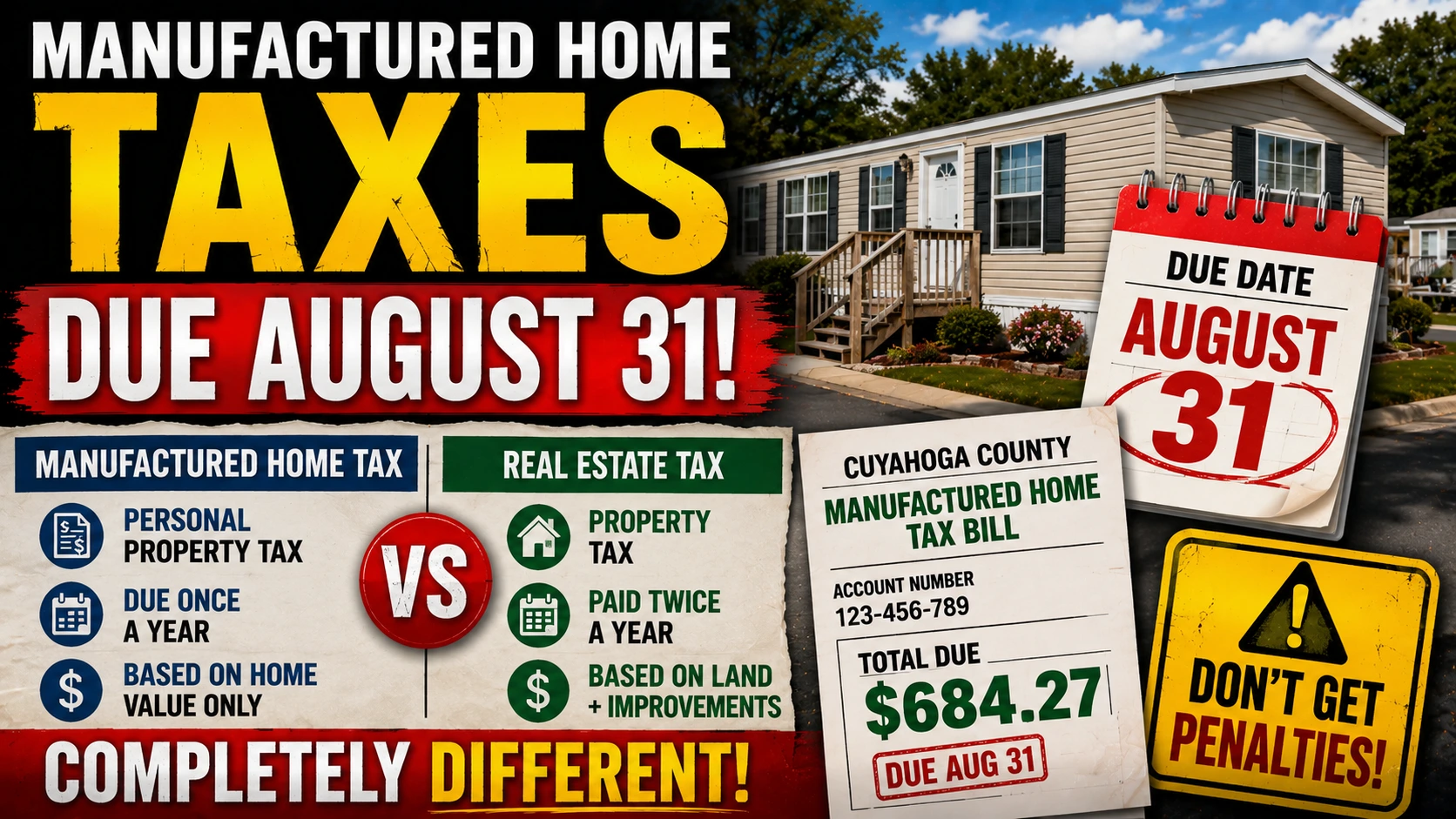
Your neighbor in a stick-built house got their second-half tax bill in the mail around July 13. Their deadline is August 13. Yours arrived around July 24, and your deadline is August 31. Same county. Same school district. Completely different system — and if you assumed the rules were the same, that assumption can cost you.
Manufactured home taxes in Cuyahoga County follow a separate legal framework, a separate billing calendar, and a separate set of consequences for missing a payment. Most homeowners who live in manufactured homes don’t know this until something goes wrong.
The belief that gets people into trouble
The widespread assumption is that all Ohio property taxes work the same way: the county sends you a bill for last year’s taxes, you pay it twice a year, and life goes on. That is exactly how real estate taxes work. It is not how manufactured home taxes work.
<cite index=”3-1″>Real estate property taxes in Cuyahoga County are billed in arrears — taxes accrued in 2025 are due in 2026.</cite> If you own a traditional home, the bill you just received covers last year. You are always paying one year behind.
<cite index=”3-1″>Manufactured home property taxes are billed for the current year. Taxes accrued in 2026 are due in 2026.</cite>
That is not a minor procedural difference. It means that if you buy or sell a manufactured home, the tax math at closing works differently than it would for a house on a permanent foundation. It means that manufactured home owners are never “caught up” in the way real estate owners are — they are paying in real time, not in arrears. And it means that the timing of your bills, your deadlines, and your penalty exposure all follow a different calendar from what everyone else around you is dealing with.
How the law actually structures this
Ohio Revised Code Section 4503.06 is the statute that governs manufactured home taxation. Under that section, <cite index=”26-1″>the assessable value of the home is thirty-five per cent of its true value</cite> — the same 35% formula that applies to real estate. That part is consistent.
What differs is the legal classification. <cite index=”13-1″>The annual manufactured home tax allows an owner to choose between being taxed under ORC 4503.06, or having the manufactured home taxed as real property under Ohio Revised Code Title 57.</cite> Most manufactured home owners in Cuyahoga County are taxed under 4503.06 by default — which means they are on the manufactured home tax list, not the general real property tax list, and their bills, deadlines, and penalty structures are governed accordingly.
The Cuyahoga County Fiscal Office assesses the value of each manufactured home. <cite index=”12-1″>The county auditor is required to have each home viewed and appraised at least once in each six-year period, in the same year in which real property in the county is appraised</cite> — so manufactured home owners did go through the same 2024 reappraisal cycle that has been driving up real estate bills across the county. The reappraisal years align. The billing cycle doesn’t.
What the August 31 deadline actually means
<cite index=”5-1″>Manufactured home property tax bills for the second half of 2026 were mailed on or around July 24, 2026, and are due August 31, 2026.</cite> That comes directly from the Cuyahoga County Treasurer’s website.
<cite index=”29-1″>The office will be open from 8 a.m. to 6 p.m. Monday, August 10 through Thursday, August 13 for extended collection hours</cite> — but note: those extended hours are for real estate taxpayers meeting the August 13 deadline, not manufactured home owners. Your deadline is August 31.
Miss August 31, and the penalty is automatic: a 10% charge applied to your unpaid balance. Under Ohio law, you get a narrow buffer — if you pay within 10 calendar days of the closing date, a reduced penalty may apply — but once that window closes, there is no negotiating with the number. The Treasurer’s Office does have an Application for Remission of Real Property and Manufactured Home Late-Payment Penalties available, but remission is not guaranteed.
On a manufactured home with a $1,200 annual tax bill, missing the second-half payment entirely means a $60 penalty hit on a $600 installment. Small in absolute terms. Avoidable entirely.
What “current year” billing means when you sell or buy
This is where the real estate arrears assumption causes the most damage.
When a traditional homeowner in Parma or North Royalton sells their house, the buyer gets a tax proration credit at closing — money from the seller to cover the portion of last year’s taxes that the seller lived there. The system works backward.
When a manufactured home changes hands, the math is different. Because taxes are billed for the current year, the seller may already owe taxes for months they haven’t lived there yet — or the split of what’s owed is calculated against 2026 charges, not 2025. Anyone involved in a manufactured home sale in Cuyahoga County needs to confirm with a title company or attorney how proration is being handled, because defaulting to the standard real estate approach will produce the wrong number.
<cite index=”19-1″>Ohio Revised Code 4505.11 requires that all manufactured home taxes must be endorsed by the Treasurer as paid in full before a title transfer can occur.</cite> That is a hard stop. If there are unpaid manufactured home taxes on the account — including any balance from earlier in 2026 — the title cannot move until the Treasurer endorses it as clean. Sellers who don’t know this find out at closing, at the worst possible moment.
The conversion option most owners don’t know about
There is a path out of the manufactured home tax system entirely. <cite index=”13-1″>A manufactured home that acquired situs in Ohio on or after January 1, 2000, or one in which ownership was transferred on or after that date, can be converted to real property status and therefore subject to the real property tax.</cite>
The requirements: <cite index=”13-1″>the home must be affixed to real property owned by the homeowner, placed on a permanent foundation, and the certificate of title must be inactivated.</cite>
Once converted, the home moves off the manufactured home tax list and onto the general real property tax list. It would then be billed in arrears like every other house in Cuyahoga County — which changes your cash flow, your deadlines, and potentially your eligibility for certain tax credits that apply to real property but not to manufactured homes taxed under ORC 4503.06.
Whether conversion makes sense depends on your specific situation. It is worth a conversation with the Cuyahoga County Fiscal Office before assuming your current classification is the right one.
The two dates that matter for the rest of 2026
If you own a manufactured home in Cuyahoga County, here is where things stand right now:
August 31, 2026 — Second-half manufactured home tax payment due. Bills were mailed around July 24. If you haven’t received yours, call the Treasurer’s Office at 216-443-7400, Option 1, before you miss the deadline waiting on a bill that may have gone to the wrong address.
January 1, 2027 — The Board of Revision complaint window opens for Tax Year 2025 valuations. <cite index=”12-1″>Under ORC 4503.06, any owner of a manufactured home — or any party authorized to file a complaint under ORC 5715.19 if the home were real property — may file a complaint against the true value of the home.</cite> If the 2024 reappraisal pushed your assessed value higher than your home’s actual market value, January 1 is when you can start the process to challenge it.
Pay online — and don’t mail it late
The Treasurer’s website accepts e-check payments with no transaction fee. <cite index=”28-1″>Credit and debit card payments carry fees — debit cards at a flat $2.95 and credit cards at 2.3% with a minimum charge of $1.50.</cite> If you are mailing a check, the USPS postmark warning that applies to real estate taxpayers applies equally here: postmark dates now reflect when mail is processed by sorting machinery, not when you dropped it in the box. If you are mailing close to August 31, mail it early or request a hand-stamped postmark at the post office counter.
The August 13 deadline applies to your neighbor’s house. August 31 applies to yours. Know the difference before the calendar gets away from you.