

Your neighbor’s house sold at a sheriff’s auction last spring. You had nothing to do with it. You made every payment, kept up the lawn, replaced the roof when you needed to. And yet, when Cuyahoga County’s 2024 sexennial reappraisal results arrived, your property value had shifted — shaped in part by sales you never made and decisions you never chose.
That is how the assessment system works. And for thousands of Ohio homeowners, that invisible link between a foreclosed property down the street and their own tax bill is one of the least understood forces in personal finance.
The connection is real, documented, and consequential. Understanding it may be the most important thing a Cuyahoga County homeowner does this year.
What Happened
Under Ohio state law and Department of Taxation rules, real property in Cuyahoga County is reappraised every six years by state-licensed appraisers. The most recent cycle concluded in 2024.
On July 9, 2024, the Cuyahoga County Fiscal Officer released newly appraised values for properties within the county’s jurisdiction. The average value increase across the county was 32.22% for residential property.
But that countywide average masks a deeply uneven story — one where foreclosure history plays a direct role in which neighborhoods saw the largest swings and which were left behind.
Why This Matters for Homeowners
When the county’s appraisers set your home’s value, they do not simply look at your house. Recent sales data from comparable properties in your neighborhood play a critical role in determining value.
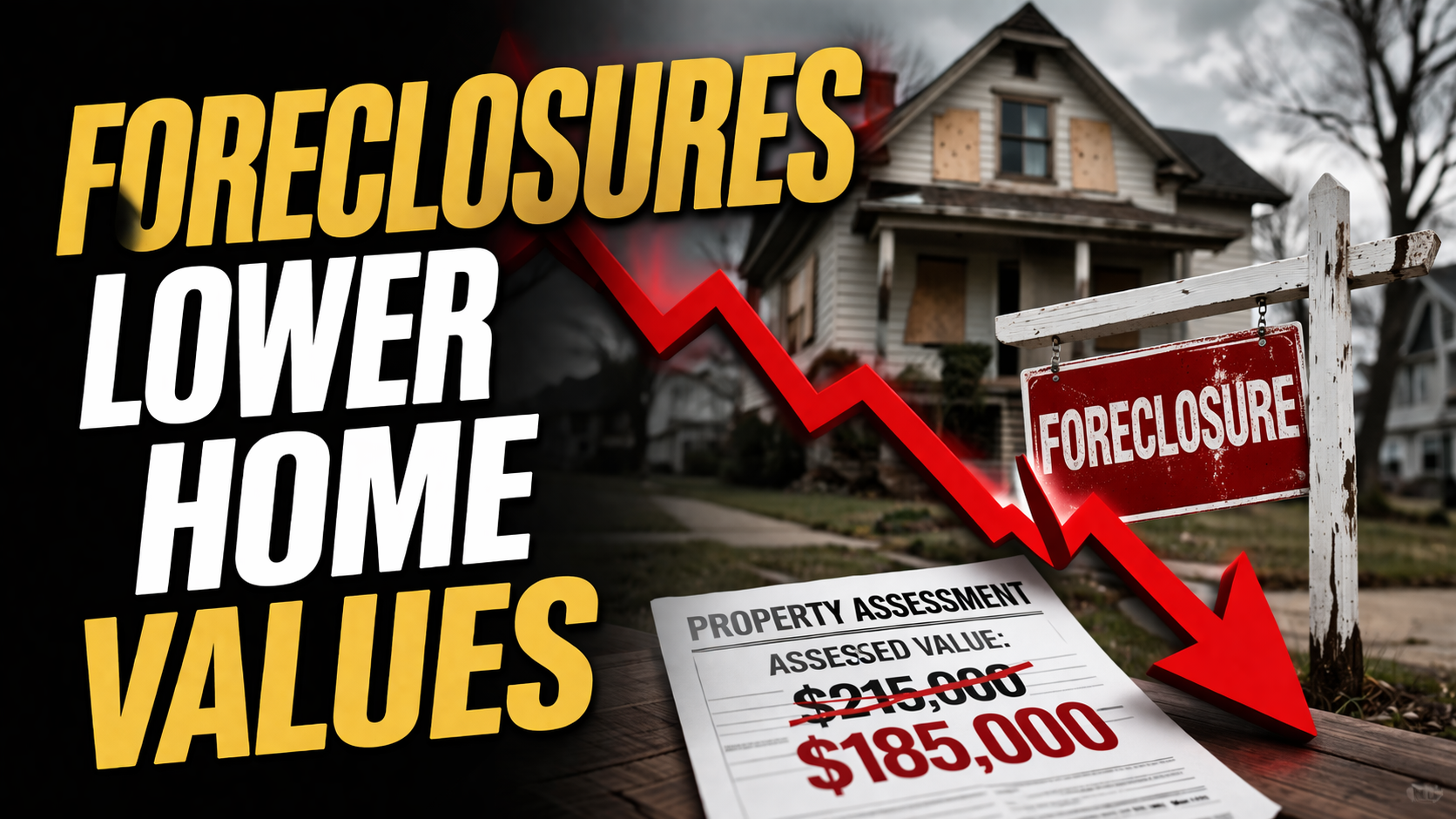
Foreclosure sales are often distressed, deeply discounted transactions. When those sales become the primary comparable data in a neighborhood, they pull assessed values downward — even for homes that were never in default.
Areas historically hard hit from the foreclosure crisis are seeing only slight or minimal increases in value, not the spikes making headlines elsewhere. As one housing expert noted, this is still felt unequally — on one hand, those homeowners aren’t being hit with higher taxes, but they also aren’t seeing an increase in their biggest financial asset.
That is the double bind foreclosures create. They can suppress assessments and, in turn, suppress generational wealth.
Who Is Most Affected
The burden falls heaviest on inner-ring Cleveland communities.
County increases ranged from an average of 15% for Hunting Valley to 67% for East Cleveland and 66% for Maple Heights and Newburgh Heights — communities where the foreclosure crisis also hit hardest, and which still have not surpassed their 2006, pre-Great Recession property valuations.
Think about what that means in human terms. A homeowner in Maple Heights who has owned their house for 20 years has watched it still trail the value it held almost two decades ago — because distressed sales in the surrounding area kept pulling the market down during every appraisal cycle since.
A Federal Reserve Bank of Cleveland study found that each property that had been in foreclosure at some point over the prior 12 months lowered the value of all homes within 500 feet of it. That radius covers an entire block. Often more.
The Financial Impact Explained
Here is a concrete scenario. Suppose a homeowner in a Cleveland inner-ring suburb owns a property the county appraised at $95,000 in 2024. In Ohio, the taxable assessed value is set at 35% of appraised value — so the assessed value would be $33,250.
One mill costs $1.00 for every $1,000 of assessed value per year. At a hypothetical total millage rate of 80 mills, the annual tax bill would be approximately $2,660.
Now consider what happens in a recovering neighborhood where foreclosure activity is lower. A $100,000 house in Cleveland that rises to $149,000 under reappraisal would see property taxes increase from $2,645 to $3,098. A higher assessment reflects real market recovery — but recovery is uneven, and foreclosure density is a primary reason why.
Researchers estimated that eliminating all housing blight associated with vacancies, foreclosures, and tax delinquency would result in a gain of over $100 million to housing values across Cuyahoga County. That figure represents value currently being silently drained from homeowners who did nothing wrong.
What You Should Do Now
Start by looking up your property’s current assessed value through the Cuyahoga County Fiscal Officer’s MyPlace portal at myplace.cuyahogacounty.gov.
Check recent sales in your neighborhood using the Cuyahoga County Residential Sales Finder, which includes all residential sales since 2018. Also review your property’s recorded characteristics — square footage, bathrooms, and other details — to ensure no errors exist in the county’s records.
If distressed or foreclosure sales are skewing the comparables in your area, that is documented, legitimate grounds for a challenge. Gather evidence: a recent independent appraisal, photographs of your property’s condition, and any documentation of improvements made since the last cycle.
Property owners should avoid comparing their property’s assessment to that of other properties when filing. The stronger approach is to provide supporting documentation including a complete appraisal report from within the last 36 months, photographs of existing conditions, and certified repair estimates if applicable.
Important Dates and Deadlines
The 2024 reappraisal cycle is now active and its valuations will remain in effect through 2030.
The 2024 reappraisal establishes tax liabilities through 2030, meaning errors in this cycle can have long-lasting financial effects.
Formal complaints with the Cuyahoga County Board of Revision are filed between January 1 and March 31 of the applicable year. Property owners filing a formal tax complaint can do so electronically via DTE Form 1, by U.S. mail, email at BORinfo@cuyahogacounty.gov, or by fax at 216-443-8282. The Board of Revision is located at the Cuyahoga County Administrative Building, 2079 E. 9th Street, 2nd Floor, Cleveland, Ohio 44115.
For general valuation questions, the Fiscal Office can be reached at 216-443-7420, option 3, or at fiscalquestions@cuyahogacounty.gov.
Official Context and Background
The sexennial appraisal is much greater in scope than a triennial update, requiring every parcel in Cuyahoga County to be physically viewed by a state-licensed appraiser before the property can be valued. Appraisers are provided with three approaches to value — cost, market estimate, and multiple regression analysis — along with neighborhood-specific reports including recent sales and Board of Revision decisions.
Ohio is a judicial foreclosure state, meaning that once a property has been foreclosed upon, it is seized by the county sheriff and auctioned off. Those sheriff’s sale prices enter the public record and become part of the comparable sales data the Fiscal Officer’s appraisers review when setting neighborhood values.
The Cuyahoga County Auditor’s Office currently manages almost 570,415 parcels and handles thousands of tax payments and property search requests every year. The scale of that work makes it essential for individual homeowners to verify their own data rather than assume accuracy.
Key Takeaways
Foreclosed properties do not just harm the families who lose them. Through the comparable sales mechanism used in every Ohio reappraisal, they affect property assessments — and ultimately tax equity — for every homeowner within close proximity.
The 2024 sexennial reappraisal is now locked in through 2030. That six-year window makes acting on valuation concerns now a financial priority, not an option.
Cuyahoga County provides free tools — the Residential Sales Finder, MyPlace property search, and a tax estimator — to help homeowners understand their assessments before deciding whether to file a complaint.
The Board of Revision complaint process exists for this reason. Use it.
Frequently Asked Questions
How do foreclosure sales affect my home’s assessed value?
Foreclosure sales are recorded transactions. When appraisers establish neighborhood values using comparable sales data, discounted foreclosure sales lower the baseline. If foreclosures are common near your home, they can pull your assessed value below true market worth.
Does a higher assessed value always mean a higher tax bill?
Not automatically. Tax rates do not increase proportionally to changes in property value due to Ohio’s House Bill 920. In some cases, a property’s tax bill may actually decrease even if its appraised value increases.
How long will the 2024 assessments remain in effect?
Through 2030, when the next sexennial reappraisal is required under Ohio law.
Can I challenge my assessment if I believe foreclosure sales are distorting my neighborhood’s values?
Yes. Market trends over the past six years in a neighborhood may have been volatile and not accurately captured. Appraisals involve human judgment and leave room for errors, so property owners have the right to contest values they feel are inaccurate. A recent independent appraisal is among the strongest forms of evidence you can submit.
Where do I start?
Visit cuyahogacounty.gov/fiscal-officer or call the Fiscal Office at 216-443-7420, option 3. The MyPlace portal and Residential Sales Finder are both free and publicly accessible.