

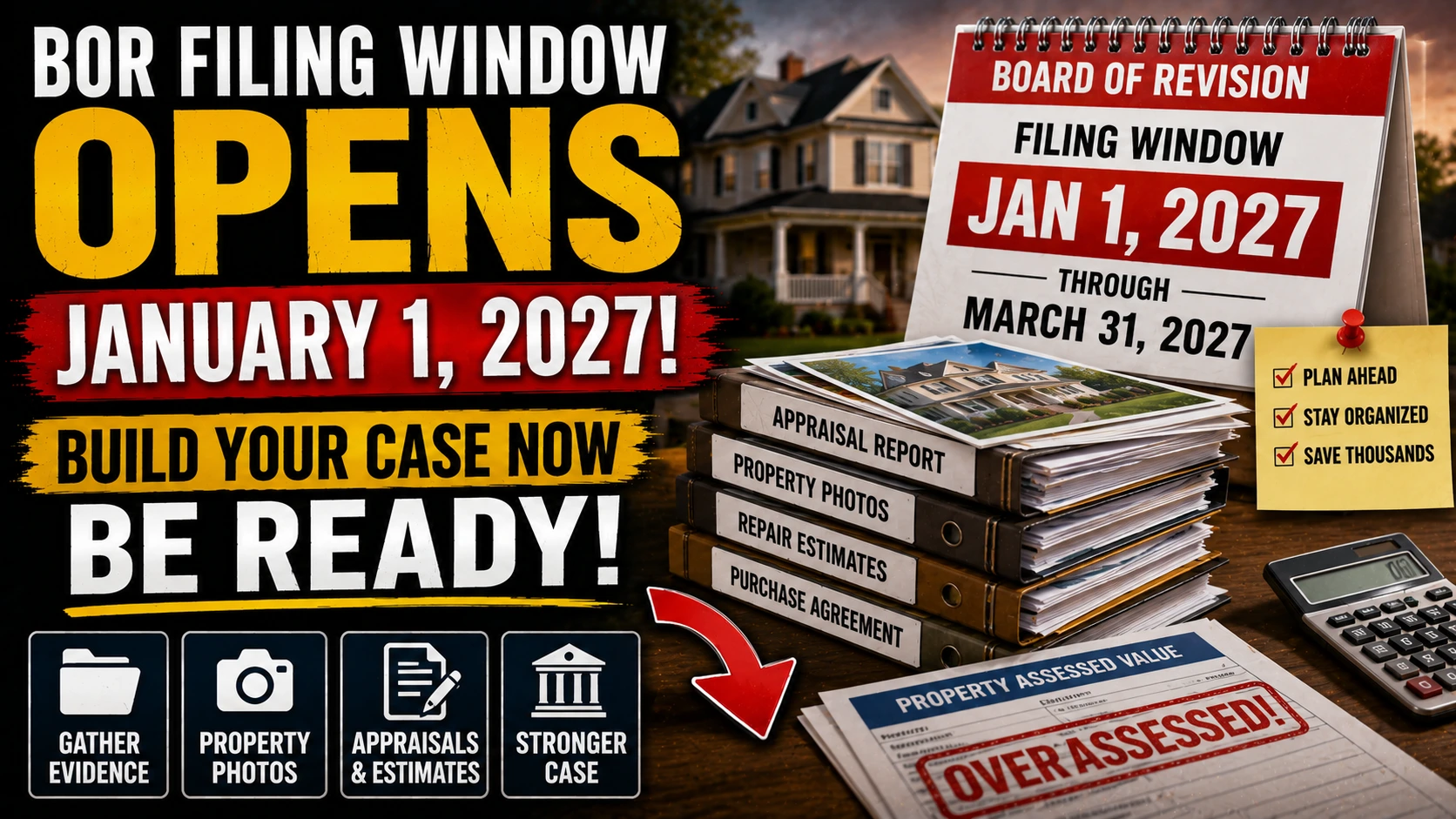
Six months from now, you will either walk into that window with a compelling case or you will spend another year paying a tax bill calculated on a number you never challenged.
The next opportunity to file a complaint against the valuation of real property with the Cuyahoga County Board of Revision runs January 1, 2027 through March 31, 2027. That is the window. The question is what you do between now and then.
Most Cuyahoga County homeowners will do nothing. They will pay their August 13 bill, put it in a drawer, and assume the county got the math right. A meaningful number of those homeowners will be wrong — and the preparation gap between those who act now and those who scramble in February will show up in the quality of their evidence, and ultimately in the Board’s decision.
Why the 2024 reappraisal created so much filing potential
The bill reflects values from a reappraisal cycle that raised residential assessments by an average of 32 percent, and in some communities the jump was far steeper. East Cleveland saw values rise by roughly 67 percent. Maple Heights saw approximately 59 percent. These are not small rounding errors. For thousands of homeowners, the assessed value the county is using bears no honest relationship to what a buyer would actually pay for the property today.
Consider what that math looks like in practice. A home in Maple Heights that carried a market value of $110,000 before the reappraisal might now carry a county-assigned market value of $174,900. Ohio taxes property at 35 percent of market value, meaning the assessed value jumped from $38,500 to roughly $61,215. At a blended millage rate around 75 mills — common in many Cuyahoga inner-ring suburbs — that translates to a tax increase of more than $1,700 per year. Not because anything changed about the house. Because the county’s appraisal department ran its models and arrived at a number.
If that number is wrong, the Board of Revision is the mechanism for fixing it.
What the BOR actually is — and why the burden falls entirely on you
The Board of Revision is responsible for investigating, hearing, and rendering decisions on all valid and timely filed valuation complaints, and it operates as a quasi-judicial body under Ohio Revised Code section 5715 and Cuyahoga County Charter Section 6.02.
That phrase “quasi-judicial” matters. This is not an informal conversation. It is a proceeding with hearing officers, evidence requirements, and formal rules. The person filing the complaint — the complainant — carries the burden of proving the opinion of value to the BOR. Hearing officers base their decisions on the evidence you provide.
The county does not have to prove its number is right. You have to prove it is wrong.
That is why the work you do between July and December 2026 will determine whether you succeed or fail.
The counter-challenge risk most homeowners never anticipate
Before walking through what to gather, there is a complication worth understanding — one that local coverage has largely skipped over.
When a homeowner files a BOR complaint seeking a reduction in assessed value, the relevant school district receives notice of that complaint. The district can respond with a counter-complaint, arguing either for the original assessed value or a higher one. For Tax Year 2024, approximately 1,800 of 9,600-plus BOR complaints drew counter-challenges from school districts.
The threshold that tends to trigger district attention is a claimed reduction of $50,000 or more in market value. If your complaint involves a gap of that size, plan your documentation accordingly. You are not just building a case for the hearing officers — you are potentially building a case against an attorney representing your school district.
This is not a reason to avoid filing. It is a reason to file with real evidence rather than a rough estimate and a good feeling.
What to gather right now, and in what order
The Board accepts several categories of evidence to support a lower valuation: an arms-length sale documented by recorded deed, closing statement, purchase contract, or conveyance fee statement; a recent appraisal report made for tax valuation purposes and authenticated by the appraiser at the hearing; certified contractor estimates for repairs cited in the complaint; and dated interior and exterior photographs of the property and comparable properties showing their condition.
Start here, in this sequence.
Pull your assessed value today. Go to myplace.cuyahogacounty.gov and search by address or parcel number. The figure listed as “market value” is the number the county is using as the basis of your bill. Write it down. Verify also that the property characteristics — square footage, bedroom count, lot size, construction type — are accurate. Errors in those fields can independently support a complaint.
Check comparable sales in your neighborhood. The county’s MyPlace portal shows recent sales activity. So does the Cuyahoga County Recorder’s office. You are looking for arms-length sales of properties similar to yours in the same general area, ideally within the last calendar year. If homes genuinely comparable to yours sold for materially less than the county’s assigned market value, you have the foundation of a case. Document those sales now. Print the listings. Save the addresses.
Consider whether a licensed appraisal makes sense. A full appraisal from an Ohio-licensed appraiser carries significant weight before the Board. The most persuasive single item is a recent arms-length sale near the lien date, but appraisals that adjust comparable sales to the lien date also carry significant weight. If your comparable sales are strong and cleanly documented, you may not need an appraisal. If the comparables are ambiguous or your property has distinctive characteristics, an appraisal is worth the investment. Commission it now if you plan to use one — appraisers are booked well in advance, and the BOR requires the appraiser to authenticate the report at the hearing.
Photograph your property’s condition. Evidence requirements include dated interior and exterior photographs of the property and comparable properties showing condition. Major structural issues — a failing foundation, water intrusion, a roof with documented problems — can support a lower valuation independent of comparable sales. Minor maintenance items typically will not. If your property has genuine condition issues, get contractor estimates in writing and have them certified. Document everything with dated photos taken before the filing window opens.
The lien date is January 1 — and that is the date that matters
One thing most homeowners get wrong about the BOR process: the Board is not evaluating what your home is worth on the day of your hearing. All evidence must relate to the lien date of January 1 of the tax year.
For the 2027 filing window covering Tax Year 2026 valuations, the relevant lien date is January 1, 2026. That is the snapshot date the county used, and that is the date against which your evidence will be measured. If you are using comparable sales, make sure they fall within a reasonable window around that date. Sales from mid-2025 through early 2026 will generally be given more weight than sales from a year or more outside that range. An appraiser familiar with the BOR process will know how to frame comps relative to the lien date. If you are building your own evidence packet, keep that date front of mind as you gather documentation.
How to file — and why filing early in the window matters
You can submit your complaint by mail, email, fax, or in person. The Board of Revision is located at 2079 East 9th Street, Second Floor, Cleveland, Ohio 44115, and is open Monday through Friday from 8:30 a.m. to 4:30 p.m., except holidays. Staff can answer questions about completing the complaint form, and notaries are typically available in the office.
The form you need is the DTE Form 1, the state-prescribed Complaint Against the Valuation of Real Property. You must enter a specific opinion of value — an exact number, not a range — and you cannot leave that field blank. The BOR will dismiss your complaint if you do not state an opinion of value.
The March 31 deadline is firm. Ohio Revised Code Section 5715.19 establishes it with no exception and no extension. Filing in January, rather than waiting until late March, gives you room to respond to follow-up requests, gather additional documentation if asked, and reschedule your hearing if a conflict arises. The people who file on March 29 with a half-built evidence packet lose that flexibility entirely.
Reach the Board directly at 216-443-7195 or by email at borinfo@cuyahogacounty.gov.
What to do before the end of 2026
- Look up your current assessed value at myplace.cuyahogacounty.gov and verify the property characteristics are accurate
- Pull comparable sales in your neighborhood from the past 12 to 18 months and document them now, before the market shifts
- If your property has condition issues that affected its value as of January 1, 2026, get contractor estimates in writing and photograph every problem with a date stamp
- Decide by October whether you need a licensed appraisal — and commission it before the holiday booking crunch hits
The window opens in six months. The case you build between now and then is the case you will present. Start before someone else’s timeline becomes yours.