

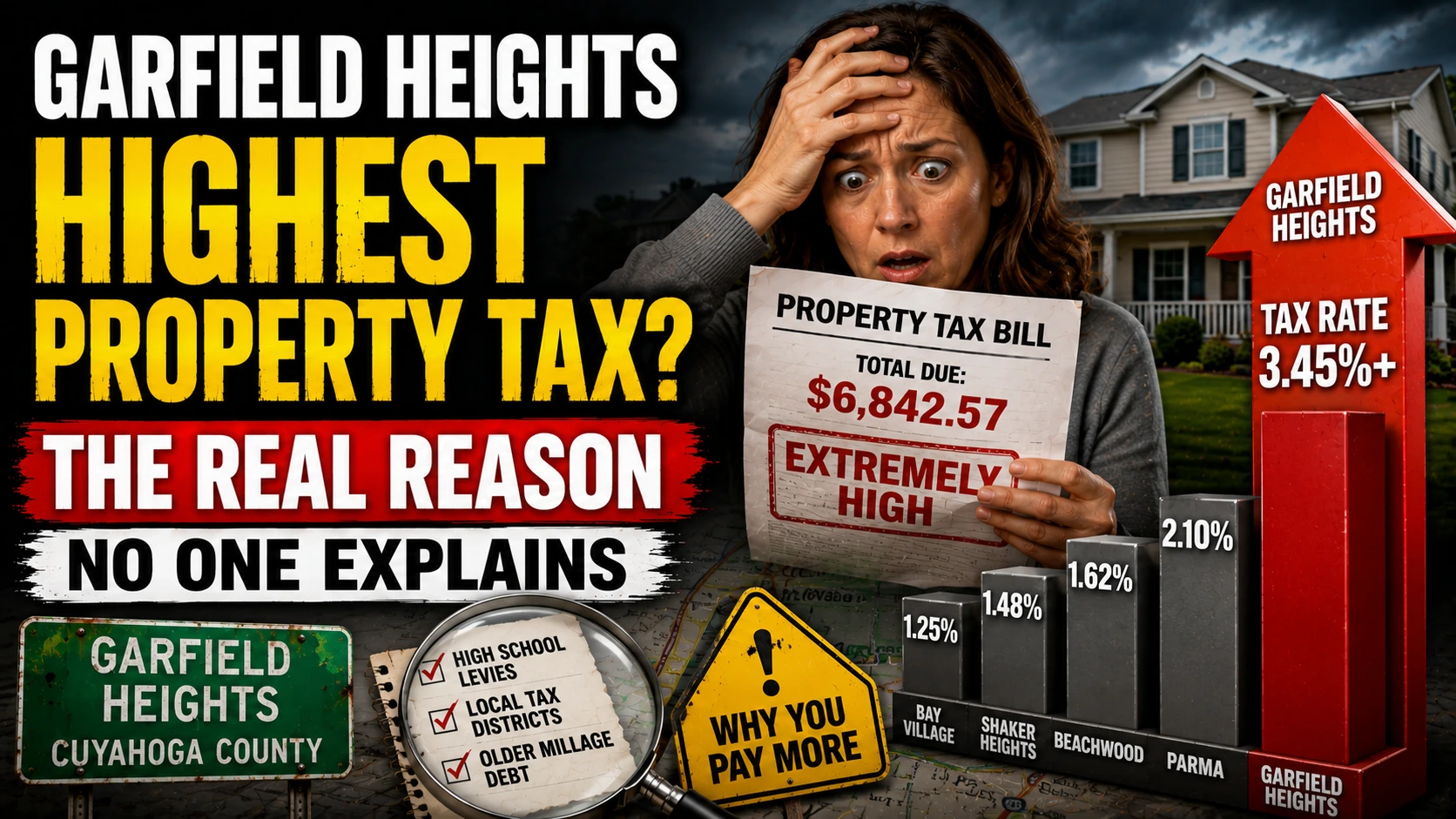
Three point seven percent. That’s roughly the effective property tax rate carried by the median Garfield Heights homeowner, and it puts the city among the highest taxed in the entire state of Ohio — higher than University Heights, higher than most of Cuyahoga County, higher than almost anywhere outside the Heights school districts. If you own a home here, you already know your bill feels disproportionate to your house. What almost nobody explains is why a modest brick colonial on a quiet Garfield Heights street can carry a tax burden that rivals homes worth twice as much in other parts of Ohio.
The short answer involves a mechanism buried in Ohio school finance law called the 20-mill floor, and it’s been quietly working against inner-ring suburbs like Garfield Heights for decades.
Your rate isn’t really about your house — it’s about what your school district is allowed to collect
Most homeowners assume their tax rate reflects the cost of local services scaled to property values. That’s true in places like Independence or Cuyahoga Heights, where effective rates sit closer to 1.7%. It is not true in Garfield Heights.
Ohio law guarantees that school districts collect at least 20 mills in current operating revenue, no matter how property values move. Garfield Heights City School District operates at or near that floor. Under normal circumstances, when home values rise during a countywide reappraisal, House Bill 920 — passed in 1976 — automatically reduces the effective millage rate so that voted levies don’t generate windfall revenue. That’s the “tax reduction factor” the Cuyahoga County Treasurer references on official rate sheets.
But HB 920’s reduction factor cannot push a district below the 20-mill floor. Once a district hits that floor, rising property values stop triggering any offsetting rate reduction. Every dollar of increased valuation becomes a dollar of increased tax bill, dollar for dollar, with no cushion.
Garfield Heights is one of the Cuyahoga County districts sitting right at that floor. That’s the mechanism nobody puts in a headline.
How Garfield Heights compares to its neighbors
Here’s where the comparison gets uncomfortable for Garfield Heights residents. Independence, just a few miles south, carries an effective property tax rate around 1.8%. Cuyahoga Heights sits even lower. Both districts have enough valuation per pupil and enough non-residential tax base that they rarely bump against the 20-mill floor — commercial and industrial property absorbs more of the load, and HB 920’s reduction factor keeps working as designed.
Garfield Heights doesn’t have that luxury. It’s a residential, inner-ring suburb with a comparatively modest commercial tax base. Within the city itself, the 44125 ZIP code carries a median effective rate around 3.55%, while the 44105 ZIP code runs closer to 3.19% — a real difference depending on which side of the city you’re on, driven by which school and assessment district your specific parcel falls into.
Put another way: the highest median tax bill in the broader Cuyahoga County area runs around $4,694, while the lowest runs around $2,822, and Garfield Heights sits well toward the higher end of that range despite home values that are nowhere near the county’s most expensive.
What the 2024 reappraisal made worse
The 2024 sexennial reappraisal pushed Cuyahoga County property values up by an average of roughly 32% countywide. In districts that still had room under HB 920’s reduction factor, that increase got partially absorbed — homeowners saw some relief baked in automatically. In Garfield Heights, sitting at the 20-mill floor, there was no absorption. The increase flowed almost directly into higher tax bills.
This is the part that catches people off guard. A homeowner in a floor district who watches their assessed value jump 30% reasonably expects their school tax rate to drop in response, the way it has in past reappraisal cycles for districts with more cushion. In a 20-mill floor district, that expectation is wrong. The rate stays locked at 20 mills, and the bill rises with the valuation almost one for one.
A real dollar comparison
Imagine two homes, each assessed at $120,000 (assessed value, not market value — Ohio taxes at 35% of market value under state law). One sits in Independence, one in Garfield Heights.
At Independence’s effective rate near 1.8%, that homeowner’s annual bill runs close to $2,160.
At Garfield Heights’ effective rate near 3.7%, the bill on an identically valued home runs closer to $4,440 — more than double, for the same assessed value, with no difference in the size or condition of the house. The gap isn’t about the home. It’s about which side of the school-district line that home sits on, and whether that district has hit its floor.
House Bill 186 doesn’t fix this for most Garfield Heights homeowners
There’s a new state credit that’s been getting attention this year — House Bill 186’s inflation cap credit, which applies to second-half 2026 tax bills and is designed specifically to offset some of the floor-district effect. It sounds like it should help here. For many Garfield Heights homeowners, it won’t move the needle much, because the credit only applies in districts where collections have exceeded a specific inflation threshold, and not every floor district qualifies the same way. Statewide, 19 of Cuyahoga County’s 32 school districts are receiving zero HB 186 credit on their current bills, and Cleveland Metro is among them. Whether Garfield Heights City Schools qualifies for a meaningful credit this cycle is worth confirming directly with the county fiscal officer’s office, since district-by-district eligibility varies (verify with county).
What is more reliably available to Garfield Heights homeowners right now is the owner-occupancy credit, currently set at 5.70% for 2026 and scheduled to climb to 15.38% by 2029 under the same legislative package — and the homestead exemption for homeowners 65 and older or permanently disabled, with a 2026 income threshold of $41,000 (Social Security income excluded from that calculation).
What you can actually do about it
You can’t vote your school district off the 20-mill floor, and you can’t undo decades of state school funding formula. But you do have leverage.
File a Board of Revision complaint if you believe your individual assessed value is wrong. The next filing window opens January 1, 2027 for tax year 2025 valuations — mark it now, because evidence gathering (comparable sales, an independent appraisal) takes time you don’t want to rush in December.
Confirm you’re receiving every credit you’re entitled to. Call the Cuyahoga County Treasurer’s office at 216-443-7400, option 1, and ask specifically whether your parcel reflects the owner-occupancy credit and whether you qualify for homestead. Plenty of eligible homeowners are missing one or both simply because they never filed the paperwork.
And if you’re weighing whether Garfield Heights’ rate structure is something you can live with long-term, understand that it’s not a temporary quirk of one reappraisal cycle. It’s structural, tied to the 20-mill floor, and it will keep behaving this way until either the school funding formula changes at the state level or the district’s tax base shifts. Neither is likely soon.
If you want to understand exactly how the 20-mill floor mechanism works at the state level — and why some Cuyahoga County districts escape it entirely — that’s worth reading next.