

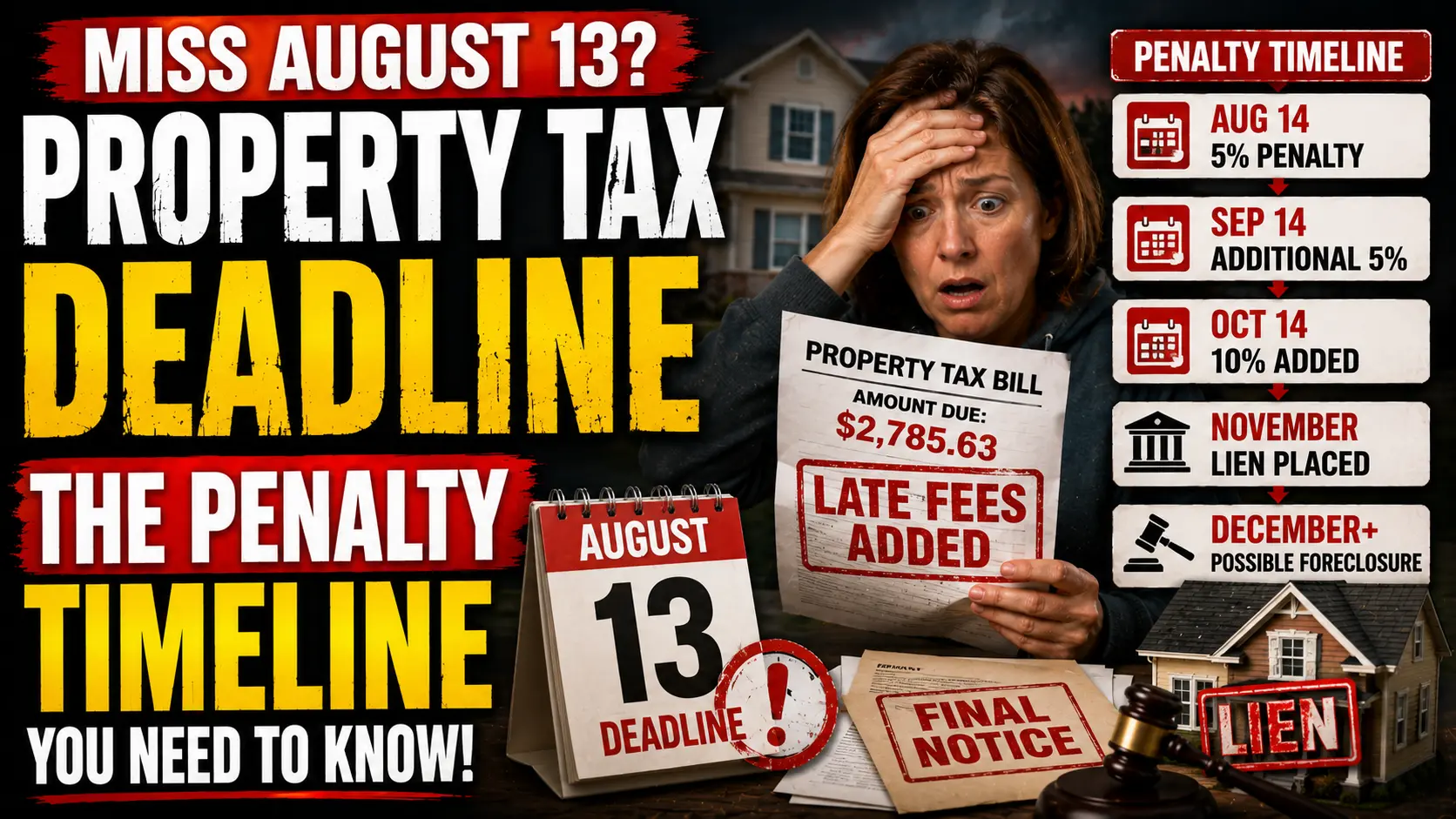
Ten days. That is the only window between a late payment and the full 10% penalty landing on your bill — and most Cuyahoga County homeowners don’t know it exists.
The second-half property tax deadline this cycle is August 13, 2026. Bills went out on or around July 13. If your payment doesn’t reach the Cuyahoga County Treasurer’s Office by August 13 — not postmarked, not submitted, but received and posted — a penalty clock starts ticking immediately. What happens after that follows a sequence most people never see coming.
The cost of missing this deadline
Start with a number. The median annual property tax bill in Cuyahoga County runs roughly $3,819 to $4,087, which puts the average second-half payment somewhere between $1,910 and $2,044.
A 10% penalty on $1,910 is $191. On $2,044 it’s $204. That money disappears the moment your payment crosses into late territory — and it does not come back.
What most people get wrong: the penalty is not assessed the day after the deadline. Ohio Revised Code Section 323.121 gives you a 10-day window after the closing date. If you pay in full within those 10 calendar days, the county treasurer is required by law to waive half the penalty. That half-penalty window closes approximately August 23, 2026 (verify the exact date with the Treasurer’s Office, as the official calendar has not yet been updated to reflect the delayed August 13 deadline).
After that window closes, the full 10% penalty stands. No exceptions. No negotiation at the counter.
The exact sequence: what happens on day 1, day 10, day 49, and beyond
Understanding the timeline matters because each stage locks in a new cost:
August 13 — Second-half taxes due. Payment must be received and posted by this date. The Treasurer’s Office treats the submission date as the posting date for electronic payments, so if you pay online, do it now — e-check and credit card transactions require 5 to 10 business days to process.
~August 23 — The 10-day half-penalty window closes. Anyone who paid between August 14 and August 23 owes 5% instead of 10%. Anyone who hasn’t paid owes the full 10% penalty with no further reduction available.
September 1 — Interest begins accruing on prior-year delinquent balances at 9% for the period ending November 30. If your unpaid balance is now classified as delinquent alongside any older debt, this rate compounds the damage.
December 1 — A second interest charge hits: 3% on the delinquent real estate tax balance for the period running from the month after the second-half deadline through November. Under Ohio Revised Code Section 323.121, counties with an active land reutilization corporation — and Cuyahoga County qualifies — can charge delinquent interest at 12% per year.
Do the math on a $2,000 unpaid second-half bill carried through December 31: you’re looking at the original $2,000, plus $200 in penalty, plus compounding interest charges that push the total well past $2,250 before the year ends.
Beyond year one — After taxes have been delinquent for one year, Ohio law authorizes the county to move toward a tax lien certificate sale. Cuyahoga County sold delinquent tax liens in 2026; the purchaser is NAR Solutions Inc., reachable at 866-960-0067. Once a lien is sold to a private company, you no longer deal with the county. You deal with them — under terms set by the certificate.
What you must do before August 13
Three things. Do all three.
Confirm your bill arrived. Tax bills were mailed on or around July 13, 2026. If you haven’t received yours, don’t assume you don’t owe. Call the Treasurer’s Office at 216-443-7400, Option 1. Bills also appear online — search your parcel at cuyahogacounty.gov using your address or parcel number.
Choose your payment method carefully. In-person payments (cash, check, money order, or card) are accepted at 2079 East 9th Street, Cleveland, and at all Cuyahoga County Auto Title locations and Key Bank branches. By phone: call 1-877-738-1212 for e-check (no fee) or card. Online at paydici.com. Mail is accepted — check, cashier’s check, or money order only, no cash — but read the warning below before you drop anything in a mailbox.
If you’re mailing, read this first. The Treasurer’s Office issued a specific notice earlier this year warning that USPS postmark practices have changed. Postmark dates now reflect when mail is processed, not when you dropped it off. A payment dropped in a neighborhood collection box on August 12 may not receive a postmark until August 14 or later. To protect yourself: take your payment directly to a post office window and request a hand-stamped postmark, or use an alternative payment method entirely.
If you genuinely can’t pay
Missing the deadline is not the end of the road. The county does have a formal process.
The Treasurer’s Office accepts a Remission of Late Payment Penalty application. If you can demonstrate that the late payment was due to circumstances beyond your control, the penalty can sometimes be waived. Submit the completed form to the Treasurer’s Office at 2079 East 9th Street, Cleveland, OH 44115, or fax it to 216-443-7463.
If your situation is more serious — multiple missed payments, existing delinquency, or a letter you’ve been avoiding — the county holds Financial Empowerment Center sessions specifically to connect homeowners with delinquency resolution resources, payment plans, and foreclosure prevention options. One is scheduled at Thea Bowman Center (11901 Oakfield Avenue) on July 1, 2026. Call 216-443-7400 for information on upcoming sessions.
A delinquent tax contract under Ohio Revised Code Section 323.31 may also be available, allowing you to pay off past-due amounts over time without triggering the full lien-sale process — but you must enter into the contract before the county certifies your parcel as delinquent.
One thing most people do not realize about their escrow account
If your mortgage servicer pays your property taxes through an escrow account, August 13 is technically their problem to manage. But it is your property, and you are the one who suffers the consequences if the servicer miscalculates.
After 2024’s sexennial reappraisal drove average countywide property values up 32.22% — with some neighborhoods like East Cleveland seeing increases closer to 67% — many escrow accounts are now underfunded. Your servicer may have adjusted your monthly escrow payment, or they may not have caught up yet. Log in to your mortgage account and confirm that the servicer has received your current tax bill and that the escrow balance covers it. If there’s a shortfall, you may receive a separate escrow deficiency notice — or the servicer may simply short-pay the county without telling you.
If there’s any doubt, call your servicer directly before August 13. Don’t assume the payment is handled.
August 13, 2026. That’s the date. Your bill arrived around July 13. You have the information you need to pay on time, avoid the penalty, and protect your account from the interest charges that follow. If anything about your bill looks wrong — a value that doesn’t match what you expected, a credit that didn’t apply — the next Board of Revision filing window opens January 1, 2027.