

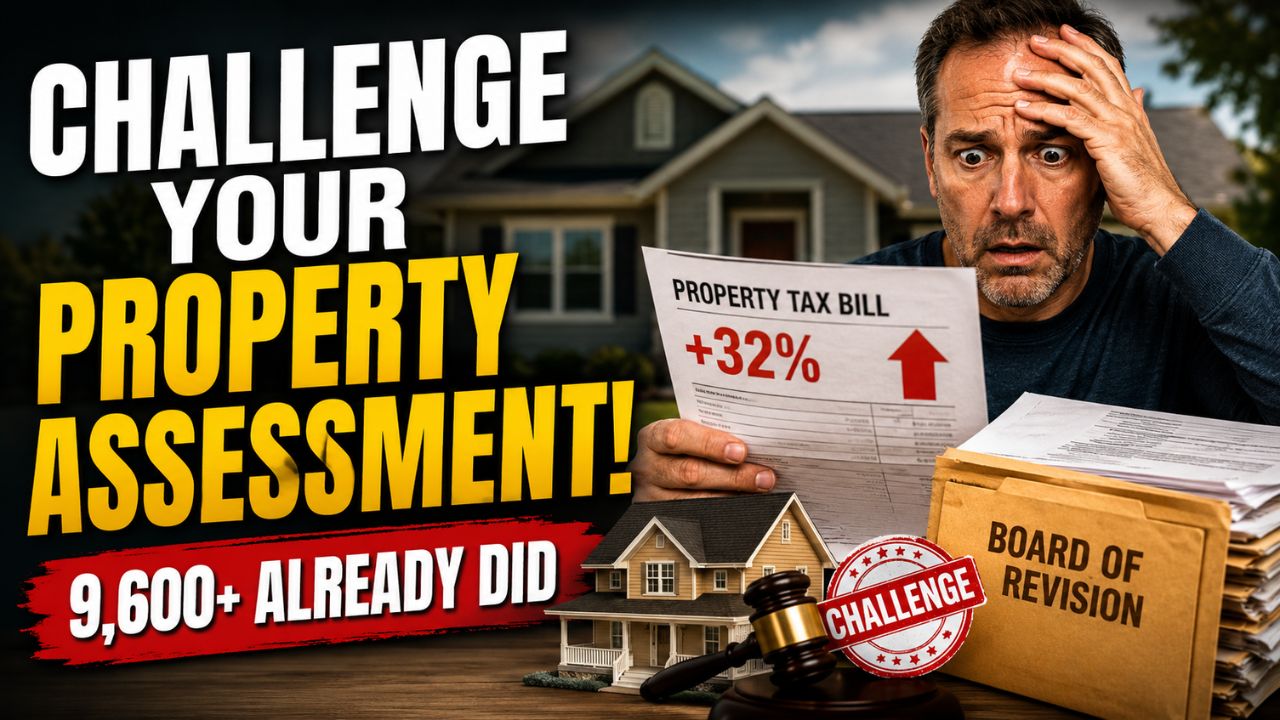
Your property tax bill arrived. The number felt wrong. Maybe it was hundreds more than last year. Maybe it was thousands.
For tens of thousands of Cuyahoga County homeowners, that moment came in waves — first when the 2024 sexennial reappraisal landed a 32% average value increase across the county, and again on December 26, 2025, when updated Tax Year 2025 values were quietly released by the Cuyahoga County Fiscal Office. Many homeowners didn’t even know a second window existed — let alone that it had a deadline.
The March 31, 2026 filing window for Tax Year 2025 values has now closed. That deadline cost some homeowners real money. But this isn’t the end of the road — and understanding what happened, why thousands of people acted, and how to prepare for the next opportunity could make a significant difference in what you pay for years to come.
What Happened: A Reappraisal That Reshaped the County’s Tax Map
Ohio law requires every county to conduct a full sexennial reappraisal every six years. In 2024, Cuyahoga County completed that process — physically reviewing more than 500,000 parcels — and the results were jarring for many neighborhoods.
The county-wide average increase was 32%. But that figure obscures what happened in specific communities.
East Cleveland saw assessed values climb by 67%. Garfield Heights, 52%. Cleveland itself, 49%. Warrensville Heights, 47%. Cleveland Heights and Euclid, both 44%. In some cases — particularly in inner-ring suburbs where out-of-state investors had been active in the market — individual homeowners saw their property values come close to doubling.
One Cleveland resident, a cancer survivor managing significant medical debt, told local reporters her home’s value had nearly doubled. She described being terrified of losing the home she had worked years to obtain.
That is not an unusual story. It is a pattern.
Why This Matters for Homeowners: The Numbers Behind the Anxiety
In Ohio, your assessed value is set at 35 percent of your home’s market value. That’s the figure your tax rate gets applied to — not the full sale price.
Here is what that looks like in practice. A home in East Cleveland with a market value of $120,000 before the reappraisal carried an assessed value of $42,000. After a 67% increase, that market value rises to roughly $200,400 — pushing the assessed value to approximately $70,140. Depending on the local millage rate, that difference can mean hundreds of additional dollars per year in taxes. Every year. Until the next adjustment cycle.
Ohio’s HB 920 provides some protection — it prevents tax rates from automatically rising at the same rate as values in many circumstances. But it does not eliminate increases. Many homeowners saw meaningful jumps regardless.
Who Is Most Affected: Long-Term Owners in Appreciating Neighborhoods
The homeowners carrying the greatest exposure are not new buyers. They are long-term residents in neighborhoods where market values have surged — often driven by investor activity, not by anything the homeowner did.
Seniors on fixed incomes. Families who bought 20 years ago and stayed. People whose incomes have not grown anywhere near 32%, let alone 67%.
By December 10, 2025 — before the Tax Year 2025 figures had fully filtered into billing cycles — the county was already owed more than $248 million in delinquent property taxes across roughly 25,000 parcels. That figure is not simply the result of neglect. It is, at least in part, a reflection of homeowners who cannot reconcile their tax bill with what they can actually afford to pay.
Extended delinquency carries real consequences. A 10% penalty activates on unpaid balances in early March. Sustained non-payment can lead to a tax lien on the property, which the county can then sell to a third-party purchaser — a process that can accelerate the path to foreclosure.
The Financial Impact Explained: What a Complaint Could Have Saved
For Tax Year 2024, more than 9,600 residential and commercial property owners filed formal complaints with the Cuyahoga County Board of Revision, according to Ron O’Leary, the BOR’s administrator.
Nine thousand six hundred. In a single filing cycle.
The BOR had not finished processing all of those cases by the time the next filing window opened. O’Leary declined to state how many resulted in reductions — the work was still underway. What is known is that many of those cases had merit, and that homeowners who filed at least created the opportunity for a correction.
Those who didn’t file for Tax Year 2025 — whether they didn’t know about the December 26 value release, missed the January 1 opening of the window, or simply let March 31 pass — have no recourse until the next cycle opens in January 2027. A full year of taxes calculated on a potentially inflated value, with no adjustment possible until then.
The Twist Most Homeowners Don’t Know: School Districts Fight Back
Here is what local coverage has largely missed, and what every homeowner needs to understand before filing any complaint.
Filing a BOR complaint does not simply trigger a review in your favor. It opens a formal proceeding — and the school district where your property is located has the legal right to file a counter-challenge.
Of the 9,600+ complaints filed for Tax Year 2024, nearly 1,800 were challenged — typically by school districts. Almost 1,000 of those counter-challenges were against residential properties. School districts have a direct financial interest: property tax revenue is their primary funding source. If a homeowner recently purchased a property for significantly more than its assessed value, a school district can use that sale as evidence to push the assessed value up — potentially higher than where the county had it.
The BOR process is governed by Ohio Revised Code Chapter 5715. It is a quasi-judicial proceeding. Both sides present evidence. Both sides are heard.
This does not mean you should not file. It means you should file with evidence — not just a feeling that the number seems high.
What You Should Do Now: Build the Case Before the Window Opens
The next BOR filing window for Tax Year 2026 values opens January 1, 2027, and closes March 31, 2027. That gives you time — if you use it.
Step one: Look up your current assessed value. Go to myplace.cuyahogacounty.gov. Enter your address. Your parcel record will show your current market value and assessed value. Compare what you see against what similar homes in your neighborhood have actually sold for in the past 12 months.
Step two: Understand what evidence the BOR accepts. The county’s official list of acceptable documentation includes:
- A complete appraisal report from the last calendar year
- Dated photographs of the property showing existing conditions that affect value
- Certified contractor estimates for repairs needed
- A purchase agreement with a closing statement, if you recently bought the property
Vague objections do not move the needle. A formal appraisal from a licensed Ohio appraiser, showing a market value lower than what the county has on record, is the most compelling evidence you can bring.
Step three: Know what gets rejected. Comparisons you pulled from Zillow. Informal estimates. Assertions that “the market has cooled.” The BOR requires documentation with dates, credentials, and specificity.
Step four: Understand the counter-challenge risk. If you recently purchased your home for significantly more than its current assessed value, filing a complaint may prompt the school district to use that sale price against you. Review your situation before filing.
Step five: File online. The BOR accepts electronic complaints via the county’s official portal — no notary required for online submissions. In-person and mail filings require a notarized DTE Form 1. The BOR office is at 2079 East 9th Street, 2nd Floor, Cleveland, OH 44115. Phone: (216) 443-7195. Email: BORinfo@cuyahogacounty.gov.
Important Dates and Deadlines
| Event | Date |
|---|---|
| 2024 Sexennial Reappraisal completed | 2024 |
| Tax Year 2025 values released | December 26, 2025 |
| TY2025 BOR filing window opened | January 1, 2026 |
| TY2025 BOR filing deadline (now closed) | March 31, 2026 |
| Tax Year 2026 BOR filing window opens | January 1, 2027 |
| Tax Year 2026 BOR filing deadline | March 31, 2027 |
| Next triennial update scheduled | 2027 |
Official Context and Background
The Cuyahoga County Board of Revision operates as a quasi-judicial body under Ohio Revised Code Chapter 5715 and Cuyahoga County Charter Section 6.02. The board is tasked with hearing formal complaints about property valuations — most commonly, Complaints Against the Valuation of Real Property filed using DTE Form 1.
The 2024 reappraisal was state-ordered and county-executed, covering all property types. The average residential increase of 32.22% was the steepest in recent memory. Commercial property values increased by an average of 8.45%, and industrial property by 8.49%.
The Cuyahoga County Fiscal Office — not the BOR — is responsible for setting valuations. The BOR is the mechanism for contesting those values after the fact. The two functions are separate.
Property tax revenue in Cuyahoga County flows to 38 cities, 19 villages, 2 townships, 33 school districts, 9 library systems, and 4 county taxing authorities. More than $3.8 billion is distributed annually. When homeowners successfully lower their assessments, it affects not just their bill — it adjusts the tax base that funds those institutions. That is why school districts have standing to intervene in BOR proceedings.
Key Takeaways
- The 2024 sexennial reappraisal raised county-wide residential values an average of 32%, with inner-ring suburbs hit hardest.
- More than 9,600 homeowners filed BOR complaints for Tax Year 2024. Nearly 1,800 were counter-challenged — mostly by school districts.
- The TY2025 filing window is now closed. The next opportunity is January 1 – March 31, 2027.
- Evidence matters. An appraisal from a licensed Ohio appraiser is the strongest tool available.
- Filing a complaint can result in a higher assessed value if recent purchase data favors the county’s position.
- $248 million in delinquent taxes already on the books as of late 2025 reflects widespread financial strain — not simply taxpayer noncompliance.
- Start building your documentation now. Don’t wait until February.
Frequently Asked Questions
What is the Board of Revision? The Cuyahoga County Board of Revision is a quasi-judicial body that hears formal complaints about property valuations under Ohio Revised Code Chapter 5715. It does not set valuations — it reviews them when challenged.
Does filing a complaint guarantee a reduction? No. The BOR reviews evidence from both sides. The school district in your area may counter-challenge your complaint, particularly if recent sales data supports a higher value.
What is the next filing window? The next opportunity to file a Tax Year 2026 complaint opens January 1, 2027 and closes March 31, 2027.
How do I find my current assessed value? Go to myplace.cuyahogacounty.gov. Search by address or parcel number. Your record will show both market value and assessed value.
What evidence carries the most weight? A complete appraisal from a licensed Ohio appraiser dated within the last calendar year. Dated photographs, certified contractor repair estimates, and a purchase agreement with closing statement are also accepted.
Can I file online without a notary? Yes. Online submissions through the county’s portal do not require notarization. Paper submissions sent by mail or in person require a notarized DTE Form 1.
What happens if I can’t pay my tax bill? Contact the Cuyahoga County Treasurer’s Office to discuss payment plan options before a delinquency escalates. Extended non-payment can result in a lien placed on your property. Phone: the Treasurer’s Office can be reached through cuyahogacounty.gov/treasury.
Sources: Cuyahoga County Board of Revision (cuyahogacounty.gov/bor); Cuyahoga County Fiscal Office; Signal Cleveland; Ohio Revised Code Chapter 5715. Data current as of May 2026.