

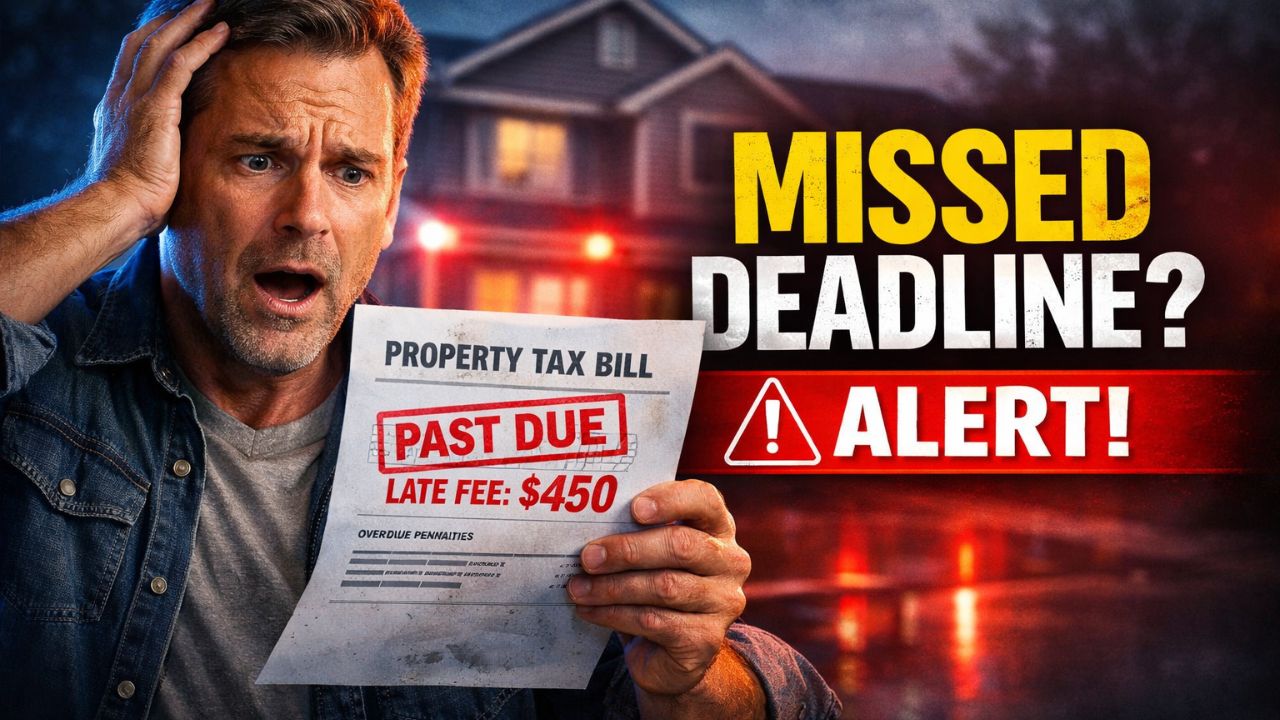
Most Ohio homeowners don’t think twice about a property tax bill until it’s too late. The due date passes, life gets busy, and a piece of mail gets buried. What comes next is a process that escalates faster than most people expect.
Missing a payment by even one day triggers automatic financial consequences. There is no grace period built into the good intentions of a homeowner. The law does not distinguish between a forgotten bill and a deliberate choice not to pay.
For Cuyahoga County residents especially, where tax bills already rank among the highest in the state, the stakes are real. A late payment is not just an inconvenience. It is the first step in a sequence that, left unaddressed, can threaten ownership of the home itself.
What Happened
The first-half deadline for Cuyahoga County property taxes for tax year 2025 was February 19, 2026. According to a notice published by the Cuyahoga County Treasurer’s Office, payments received by March 2, 2026 would not be assessed a 10% late payment penalty.
That 11-day buffer is not a formal grace period. It is a narrow window defined by Ohio state law.
As required by Ohio Revised Code 323.121, a late payment penalty of 5% is added to past-due current-year taxes if the balance is paid in full within ten days following the tax due date. Otherwise, the full 10% penalty applies.
The second-half deadline for Cuyahoga County is typically set in mid-July, with the exact date confirmed each year by the Treasurer’s Office.
Why This Matters for Homeowners
A 10% penalty sounds modest. On a large tax bill, it is not.
The median annual property tax bill in Cuyahoga County is estimated at around $3,819. That means a homeowner paying in two installments faces a first-half bill near $1,910. A 10% penalty on that half alone adds roughly $191 in a single billing cycle. That money does not apply to principal. It is purely punitive.
And it compounds. Once a bill becomes delinquent, additional interest begins to accrue. The financial gap widens the longer it sits unpaid.
Who Is Most Affected
Fixed-income retirees. Recent buyers stretched thin by closing costs. Homeowners whose mortgage servicer failed to pay from escrow on time.
These are the people most likely to find themselves one missed notice away from delinquency. It does not require financial recklessness. Sometimes it requires only one disrupted paycheck, one overlooked statement, or one mailing delay.
The Cuyahoga County Treasurer’s Office has specifically warned taxpayers that USPS postmark practices have changed, and that the postmark date reflects when mail is processed by sorting machinery, not when it was placed in a mailbox. A check mailed on the due date may not receive a valid postmark until days later, triggering a penalty the homeowner had no intention of incurring.
The Financial Impact Explained
Consider a homeowner in Cleveland Heights with a property the county auditor has assessed at a market value of $180,000. Based on typical Cuyahoga County tax rates, the annual property tax bill might run close to $4,500. That splits into two installments of roughly $2,250 each.
Miss the February deadline by more than ten days, and a 10% penalty adds $225 to that installment alone. Miss both halves in the same year, and the combined penalties approach $450 before any interest is calculated.
In some Ohio counties, once a bill is unpaid, interest accrues at 1.5% per month on top of the base penalty. That rate, running across multiple months, turns a modest shortfall into a debt that grows while the homeowner is still living in the house.
What You Should Do Now
If the February deadline has passed and payment has not been made, the first step is to pay immediately. Every additional day adds to the total owed.
The Cuyahoga County Treasurer’s Office offers payment by e-check, credit or debit card, phone, mail, and in-person at the Administrative Headquarters at 2079 East 9th Street in Cleveland. E-check payments carry no fee.
If the bill cannot be paid in full, contact the Treasurer’s Office directly and ask about a delinquent tax payment plan. Ohio law under Ohio Revised Code 323.31 allows homeowners to enter into a delinquent tax contract, making payments over time while avoiding further escalation toward foreclosure.
Do not wait for a second notice. The system does not require one before escalating.
Important Dates and Deadlines
For counties like Harrison, the 2025 first-half tax deadline was February 26, 2026, with a 5% penalty applied the following day and the full 10% penalty kicking in by March 10, 2026.
In Cuyahoga County, the first-half 2025 deadline was February 19, 2026. Taxes not paid by the closing date are charged a 10% penalty if payment is not received in full within 10 calendar days of the closing date, and postmark is not accepted for late payment purposes.
The second-half deadline for most Ohio counties, including Cuyahoga, typically falls in mid-to-late July. Homeowners should confirm the exact second-half due date with their county treasurer as early as June.
Official Context and Background
Real estate taxes in Cuyahoga County are billed in arrears, meaning that charges payable in 2026 are for tax year 2025. This billing structure confuses many new homeowners who assume they are paying for the current year.
The Cuyahoga County Fiscal Office, under the direction of the county auditor, determines property values used to calculate tax liability. The Treasurer’s Office then bills and collects those amounts twice yearly. These are separate offices with distinct roles, both governed by the Ohio Revised Code.
According to Ohio Legal Help, if property taxes go unpaid within 60 days of being certified delinquent, the case can be referred to the county prosecutor to initiate foreclosure proceedings. That process can take anywhere from several months to more than a year, but once started, it is difficult and expensive to reverse.
Key Takeaways
Missing the property tax due date in Ohio is not a minor administrative slip. It triggers a mandatory penalty under state law, begins an interest clock that runs until the balance is cleared, and puts a homeowner on a path that, unaddressed, ends in a legal proceeding.
The 10% penalty is automatic. The delinquent land list is public. And the county auditor has no discretion to waive what the Ohio Revised Code requires, absent a formal remission application filed with the county treasurer.
The good news is that options exist at every stage short of foreclosure. Payment plans are available. Penalties can sometimes be remitted under qualifying circumstances. But those options require action. They require contact with the Treasurer’s Office. They do not happen on their own.
Frequently Asked Questions
What is the penalty for paying property taxes late in Ohio?
Under Ohio Revised Code 323.121, a 5% late payment penalty is added to past-due current-year taxes if the balance is paid in full within the first ten days following the due date. After that window, the full 10% penalty applies.
Does not receiving a tax bill excuse a late payment?
No. Under Ohio law, failure to receive a tax bill does not excuse or delay the payment, nor does it excuse any penalty or interest charged. Homeowners are responsible for knowing when their taxes are due.
Can I lose my home over unpaid property taxes in Ohio?
Yes. If property taxes go unpaid, the county treasurer can start a foreclosure against a homeowner in court under Ohio Revised Code 5721.18. The court can order the home sold at auction to satisfy the tax debt.
Is there a payment plan available for delinquent taxes?
Ohio Revised Code 323.31 allows homeowners to enter into a delinquent tax contract with the county treasurer, providing for payment of delinquent taxes in installments over a period of up to five years for owner-occupied residential properties.
Who do I contact in Cuyahoga County about a late property tax payment?
The Cuyahoga County Treasurer’s Office can be reached at 216-443-7400, Option 1, for questions about real estate property tax payments and delinquency options. The office is located at 2079 East 9th Street in Cleveland.