

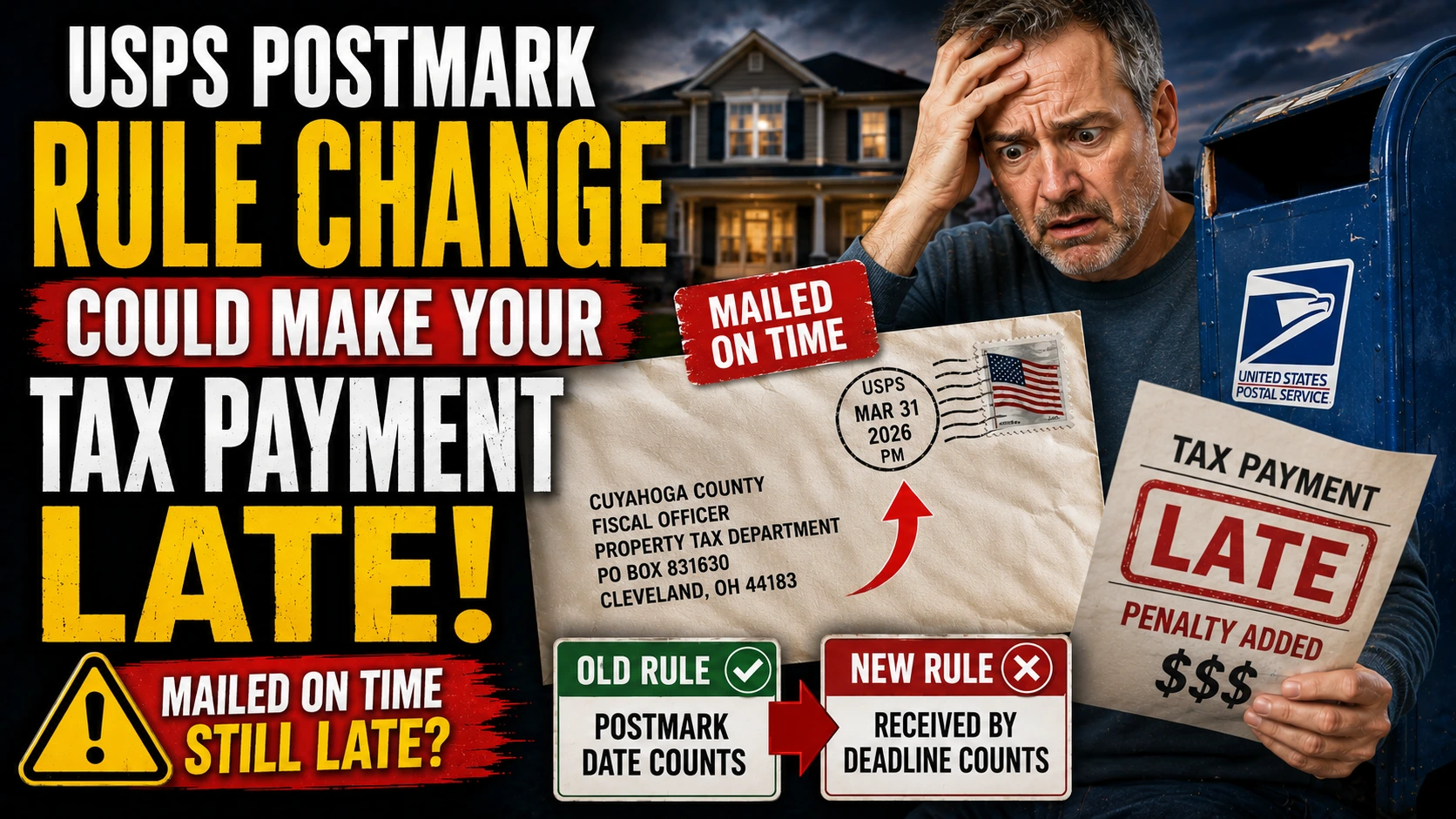
Most Cuyahoga County homeowners who mail their property tax check believe the same thing: drop it in the mailbox before the deadline, and you’re covered. The postmark protects you. That’s always been the deal.
That deal changed on December 24, 2025.
The USPS Postmark Rule Change That Could Make Your Cuyahoga County Tax Payment Late — Even If You Mailed It on Time is not a hypothetical. The Cuyahoga County Treasurer’s Office has already issued a formal public notice about it — twice, once ahead of the February 19 first-half deadline and again now, ahead of the August 13, 2026 second-half deadline. Bills are going out around July 13. That gives you a narrow window, and mailing a check the same way you always have may no longer be enough to protect you from a penalty.
What everyone assumed about postmarks
The long-standing belief is reasonable: if you mail a payment before the deadline, the postmark date proves you were on time. Under Ohio Revised Code Section 323.12, that’s technically correct — a payment is considered on time if the envelope carries a USPS postmark dated on or before the last day for payment. The law doesn’t care when the check arrives, only when the postmark says it was mailed.
For decades, that worked because a postmark reflected the date your mail entered the postal system — the day a letter carrier picked it up from your box, or the day you handed it across a post office counter. The machine stamp and the mailing date were essentially the same thing.
They no longer are.
How the postal system actually works now
On November 24, 2025, the USPS issued final regulations, effective December 24, 2025, formally defining postmarks and clarifying how they are applied. The language in the updated Domestic Mail Manual — DMM 608.11 — is blunt: postmarks at processing facilities “do not inherently or necessarily align with the date on which the Postal Service first accepted possession of the mail piece.”
What that means in plain terms: the stamp on your envelope reflects when USPS sorting machinery first processed it at a regional facility — not when you dropped it in the mailbox. This change results from the USPS “Delivering for America” infrastructure consolidation plan, which means mail may be postmarked days after being dropped off, particularly in rural areas.
The USPS itself acknowledged that this misalignment “has and will become more common” as it continues consolidating its processing network.
Put concretely: you could put your Cuyahoga County tax check in the mailbox on August 12 — one day before the deadline — and the envelope might not pass through sorting machinery until August 14 or August 15. The postmark reads late. Under Ohio law, your payment is late. The penalty clock starts.
What this distinction actually costs you
Ohio Revised Code 323.121 requires a late payment penalty of 5% if the balance is paid in full within ten days following the tax due date. Otherwise, the full 10% penalty applies.
The median annual property tax bill in Cuyahoga County runs approximately $3,819. The second-half installment is roughly $1,910. A 10% penalty on that payment adds $191 — immediately, automatically, with no negotiation available. And that’s before the 12% annual interest rate begins accruing on any delinquent balance.
A homeowner in Parma with a $220,000 assessed market value might be carrying a second-half bill closer to $2,400. The same postmark problem costs that homeowner $240 in penalties — for a check that was sitting in the mailbox the day before the deadline.
That’s not a theoretical risk. The Treasurer’s Office explicitly warned that recent changes to how USPS machinery processes envelopes mean postmark dates no longer reliably reflect the date a payment was mailed.
What the county is telling you to do instead
The Cuyahoga County Treasurer’s Office is advising taxpayers mailing payments close to a due date to: (1) allow additional mailing time, (2) request an in-person, hand-stamped postmark at the Post Office counter, or (3) use an alternative method of payment to ensure timely receipt.
The second option is the one most people don’t know about. You can walk into any USPS retail location, hand your envelope to a postal employee at the counter, and ask them to manually hand-cancel it — stamping it with the current date at the moment they accept it. Manual postmarks will be applied free of charge. That stamp is tied to the actual date of acceptance, not the processing facility’s intake clock. Under Ohio law, that’s a valid postmark.
What doesn’t work: dropping the envelope in a blue street collection box. Using a self-service kiosk inside the post office. Applying a postage meter label at home. Pre-printed labels from self-service kiosks, Click-N-Ship, or postage meters only prove postage purchase, not USPS acceptance. None of those give you a valid postmark under the updated rules.
And note this: a private meter postmark on an envelope is not a valid postmark for purposes of establishing the date of payment under Ohio law. That’s been the rule for a while. The new issue is that even a machine-applied USPS postmark may now be dated after you mailed it.
The option that eliminates the problem entirely
The county’s online payment portal at cuyahogacounty.gov/treasury accepts e-check payments at no fee. E-check and credit card payments require 5 to 10 business days for processing; the date the payment was submitted is the posting date and is the date considered for timely payment.
That last part matters. With an electronic payment, the submission date — not an arrival date, not a postmark date — is what determines timeliness. If you submit an e-check on August 12, it’s dated August 12. No postal machinery involved.
The catch: allow for that 5-to-10-business-day processing window. Don’t wait until August 12 to initiate an online payment if you haven’t accounted for processing time. Payments submitted close to the deadline with a credit or debit card carry processing fees — a flat $2.95 for debit, 2.3% (minimum $1.50) for credit. The e-check option costs nothing.
You can also pay by phone at 1-877-738-1212, or in person at the Cuyahoga County Administrative Building at 2079 East 9th Street in Cleveland. In-person payment locations accepting check or money order are also open at Auto Title offices through August 13 and at Key Bank locations through August 6.
The deeper problem with a postmark-dependent system
Ohio’s property tax statute still relies on the USPS postmark as the legal standard for payment timing. Ohio Revised Code Section 323.12 was written when a postmark meant something specific. That meaning has now been officially and formally loosened by the postal service itself — and the state legislature hasn’t updated the statute to address it.
That gap is the homeowner’s problem, not the county’s. The Treasurer’s Office is not going to waive your penalty because USPS sorting logistics delayed your postmark. The county follows the date on the envelope. If that date is after August 13, you’re late.
Cuyahoga County Treasurer Brad Cromes’ office has been more transparent about this risk than most county treasurers in Ohio — the formal notice appears on the county’s payment page, its FAQ page, and in official press releases. The information is there. Most people mailing a check haven’t read it.
Your second-half bill is arriving around July 13. The deadline is August 13. If you plan to mail a check, the only safe move is to hand it to a postal employee at the counter and ask for a manual postmark — or pay online with an e-check before August 7 to be comfortable on processing time. Call the Treasurer’s Office at 216-443-7400, Option 1 with any questions about your account or payment options.