

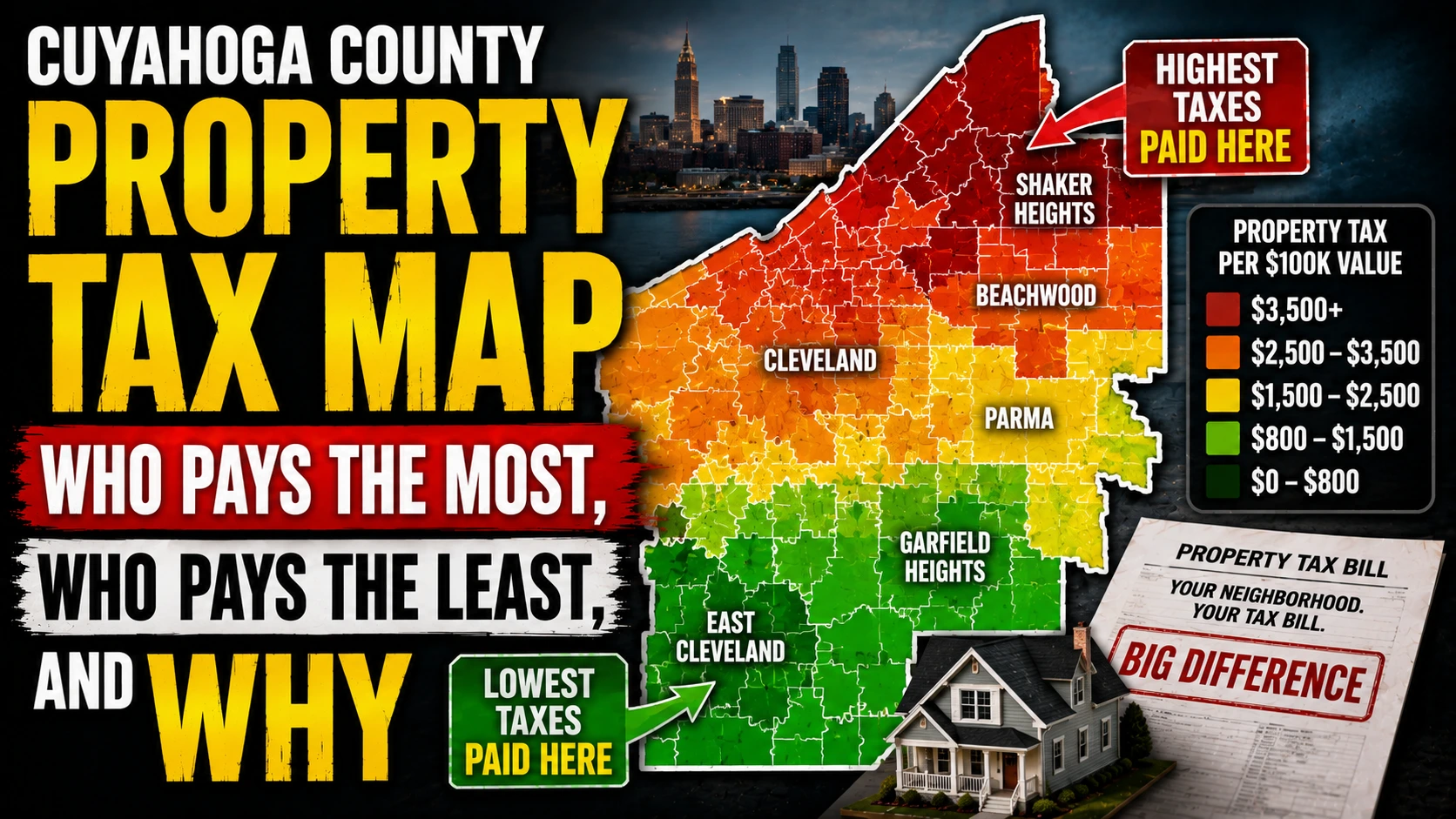
A homeowner in Cuyahoga Heights pays roughly half the effective property tax rate of a homeowner in Bedford Heights — and they might be driving distance from each other. That’s not a typo, and it’s not a fluke in the data. It’s how property tax in Cuyahoga County actually works, and almost nobody outside the assessor’s office understands why.
The Cuyahoga County Neighborhood Property Tax Map: Who Pays the Most, Who Pays the Least, and Why isn’t an abstract spreadsheet exercise. It’s the reason your neighbor two streets over, in a different school district, pays a meaningfully different bill on a similarly priced house. Cuyahoga County already carries the highest effective property tax rate of any county in Ohio. Within that county, the gap between the highest-taxed and lowest-taxed communities can run more than two full percentage points — which on a $200,000 home is the difference between a $3,300 bill and a $6,800 bill.
The number that starts the conversation
Effective property tax rates across Cuyahoga County’s cities and villages range from roughly 1.6% in places like Cuyahoga Heights and Strongsville up toward 3.4% to 3.8% in communities like Bedford Heights and parts of the Cleveland/Shaker Heights school overlap. That’s not a rounding difference. On a $250,000 home, a 1.6% effective rate produces an annual bill near $4,000. A 3.4% effective rate on the same home produces a bill closer to $8,500.
Your house doesn’t decide that number. Your address does.
Why your city’s rate is what it is
Cuyahoga County itself doesn’t set the rate that lands on your bill. The county fiscal office determines your home’s market value, applies Ohio’s 35% assessment ratio, and then multiplies that assessed value by the total millage approved for your specific taxing district. That millage is a layered stack: county-wide services, your city or village, your school district, your library system, your park district, and in some cases a community college levy. Each layer is voted on separately, by separate residents, at separate times.
This is the part most people get wrong. They assume “Cuyahoga County property tax” is one rate that applies countywide. It isn’t. It’s closer to 100 different overlapping taxing districts, each with its own voter-approved levies stacked on top of the same 10 mills of unvoted tax guaranteed by the Ohio Constitution.
A school district that has passed several operating levies over the past two decades — often because state funding formulas pushed more of the burden onto local property owners — will carry a heavier load than a neighboring district that hasn’t gone back to voters as often.
How it compares to neighbors
Take two real examples from the 2024 sexennial reappraisal. East Cleveland’s home values jumped roughly 67% countywide-average reassessment, while Maple Heights saw close to 59%. Compare that to Cuyahoga County’s average residential increase of 32.22%. Both East Cleveland and Maple Heights are inner-ring suburbs with older housing stock and school districts that rely heavily on local property tax revenue rather than a deep commercial tax base.
Now compare that to a community like Strongsville or Olmsted Falls, where newer housing, a broader commercial and industrial tax base, and lower per-pupil reliance on residential levies keep the effective rate lower even as home values climb.
This is where House Bill 186 becomes relevant, and where the gap between neighbors gets stranger. HB 186 created a new inflation cap credit meant to stop school district tax collections from outpacing inflation in districts sitting on the state’s 20-mill floor. Sounds like relief for everyone. It isn’t. According to Signal Ohio’s reporting on the legislation, 19 of Cuyahoga County’s 32 school districts will receive no tax cut at all under HB 186, including the Cleveland Metropolitan School District. Another nine districts get a reduction so small — under $10 per $100,000 of value — that most homeowners won’t notice it on their bill.
So the same legislation that Columbus lawmakers are calling historic property tax relief will show up on your second-half 2026 bill as a real discount if you live in one of roughly a third of Cuyahoga’s districts, and as nothing at all if you live in most of the rest, Cleveland included.
What drives the difference
Three things explain almost every gap on this map.
School district reliance on local levies. Districts with weaker commercial and industrial tax bases lean harder on homeowners. That shows up directly in your millage.
Reappraisal timing and magnitude. The 2024 sexennial reappraisal didn’t hit every community the same way. Inner-ring suburbs with hot resale markets since 2018 saw value jumps two to three times the countywide average, while more stable or already-expensive markets saw smaller percentage increases — even though their dollar totals may still be higher.
The 20-mill floor and HB 186 eligibility. Whether your school district is sitting at the legal floor, and whether it qualifies for the new inflation cap credit, has nothing to do with your home individually and everything to do with decades of levy history in your specific district.
None of this is determined by the county fiscal office’s appraisal alone. The fiscal office sets value. Your neighbors, your school board, and your city council set the rate that gets applied to that value.
What you can do about it
You can’t change which taxing district your address sits in. You can make sure the value side of the equation is accurate, since that’s the only half of the formula you have any real leverage over.
If your 2024 reappraisal notice valued your home above what comparable sales in your neighborhood support, the Board of Revision complaint window reopens January 1, 2027 for Tax Year 2025. That’s a formal complaint process under Ohio Revised Code Section 5715.19, and it requires documentation — comparable sales, a licensed appraisal, or evidence of property condition that the mass appraisal missed.
Three things worth doing before that window opens:
- Pull your most recent valuation notice and compare it against actual closed sales on your street from the past 12 months, not listing prices
- Check whether your school district is one of the 19 receiving zero HB 186 credit, since that affects how much relief to expect on your August bill
- Call the Cuyahoga County Treasurer’s office at 216-443-7400, Option 1, if your city or school district rate on your bill doesn’t match what you expected from this comparison
The map of who pays what in Cuyahoga County was drawn one levy vote at a time, over thirty years, by people who aren’t you. Understanding it is the only way to know whether your bill reflects the system working as designed, or a value the county got wrong.