

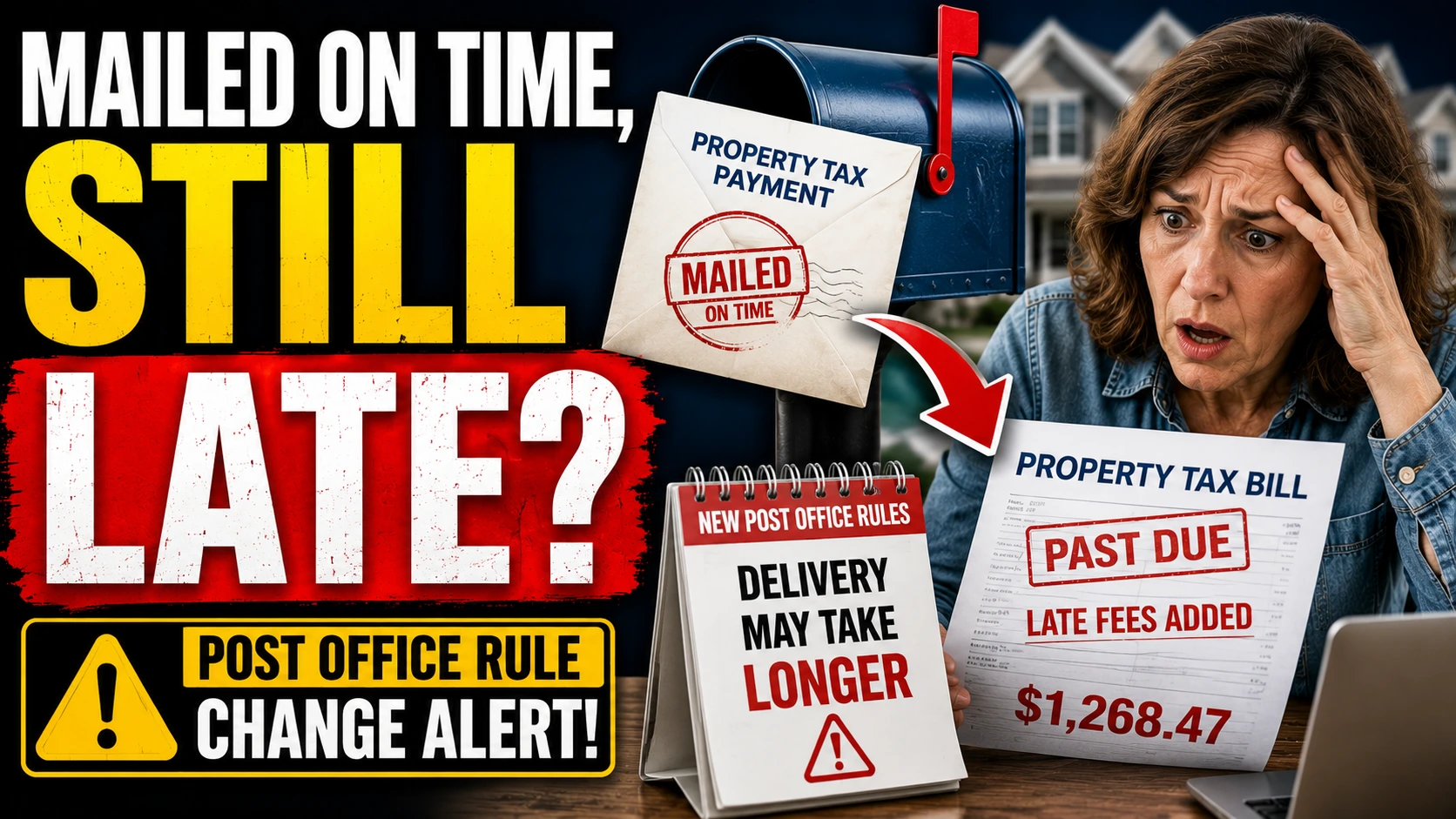
You sealed the envelope. You put a stamp on it. You dropped it in the blue mailbox before March 31.
And your Board of Revision complaint still got rejected.
That scenario played out for some Cuyahoga County homeowners during the TY2025 filing window — and it had nothing to do with their paperwork. A sweeping change to how the United States Postal Service assigns postmark dates, effective December 24, 2025, quietly shifted the rules for anyone mailing deadline-sensitive documents. The BOR deadline has now passed. But with the next filing window opening January 1, 2027, what happened this spring is a warning every Ohio homeowner needs to hear before the next one arrives.
What Happened
On December 24, 2025, the USPS updated its Domestic Mail Manual — specifically Section 608.11, “Postmarks and Postal Possession” — as part of its “Delivering for America” infrastructure overhaul. The rule clarified that a postmark date generally reflects either the date of the first automated processing operation performed on a mailpiece, or the date the mailpiece was first accepted at a retail counter.
That distinction sounds minor. It isn’t.
Under the old, widely understood convention, the postmark reflected the date you dropped your mail at a USPS mailbox or post office. Under the new rule, the postmark shows the date your envelope is first processed by an automated USPS sorting machine — which could be days later.
Mail dropped in a blue collection box may not receive a postmark until it reaches an automated sorting facility. For letters originating more than 50 miles from a USPS regional processing and distribution center, the postmark date could be one to three days later than the actual date of mailing.
The USPS itself acknowledged the gap. The Postal Service noted this is not a formal change in practice, but confirmed it has made adjustments to its transportation operations that will result in some mailpieces not arriving at originating processing facilities on the same day they are mailed.
Why This Matters for Cuyahoga County Homeowners
The Cuyahoga County Board of Revision has a strict postmark rule — and it predates the USPS change. For the TY2025 filing window, all complaints were required to be received by the BOR by 11:59 p.m. on March 31, 2026, or bear a United States Postal Service postmark of March 31, 2026 or earlier. The BOR explicitly stated it would reject all complaints bearing non-USPS postmarks received after March 31, 2026.
That last part matters enormously. FedEx. UPS. Pitney Bowes meter. None of them count.
Only an official USPS postmark on or before the deadline gives a late-arriving envelope a fighting chance. And thanks to the December 2025 rule change, that postmark is no longer guaranteed to reflect the day you actually handed the envelope to anyone.
Pre-printed labels from Self-Service Kiosks, Click-N-Ship, or postage meters only prove postage was purchased — not that the USPS accepted possession on that date. This includes certified mail stickers obtained from self-service kiosks. Without an official USPS acceptance stamp, these items cannot serve as proof of mailing date for deadline-sensitive filings.
Put simply: a homeowner who used a self-service kiosk, slapped on a pre-printed label, and dropped their complaint in a blue box on March 31 may have lost their right to appeal — even though they acted in good faith on the deadline date.
Who Is Most Affected
The stakes here are not abstract. Following the 2024 sexennial reappraisal, residential property values across Cuyahoga County rose an average of 32 percent. In inner-ring suburbs like East Cleveland and Mayfield Heights, some parcels nearly doubled in assessed value. Long-term homeowners — people who bought decades ago when values were modest — woke up to tax bills calculated on dramatically inflated numbers they had no part in creating.
More than 9,600 property owners filed BOR complaints for tax year 2024. That number signals how many households recognized their assessments were out of step with reality. As of December 2025, Cuyahoga County was carrying more than $248 million in delinquent property taxes — a figure that reflects how many residents are already financially strained under the current burden.
For that population, a missed filing deadline isn’t a bureaucratic inconvenience.
It’s a year — or more — of overpaying on a bill that should have been lower.
The Financial Impact Explained
Here is what the numbers look like in practice.
Cuyahoga County assesses residential property at 35 percent of its estimated market value. If a home was reappraised from $180,000 to $237,600 — a 32 percent increase — the taxable value rises from $63,000 to $83,160. At a combined effective millage rate of roughly 80 mills (typical for many inner-ring communities), that increase translates to approximately $1,609 more per year in property taxes.
A successful BOR complaint that restores the original value saves that homeowner roughly $134 per month.
Missing the filing deadline means waiting until the next window — which, per the official Cuyahoga County BOR website, does not open again until January 1, 2027, through March 31, 2027.
That is twelve additional months of paying at the inflated rate. For households already struggling, that gap is real money.
The Other Trap Most Homeowners Don’t Know About
Even homeowners who filed correctly by the deadline faced a risk most local coverage ignored entirely: the school district counter-challenge.
If a property owner is seeking a change in value of $50,000 or more, the local school district can file a counter-complaint. If the school district believes the property value should stay at the county-assessed level — or even be increased — it can file a counter-complaint with its own opinion of value. Just like with an original filing, the school district must present evidence to justify its position.
For the TY2024 cycle, 1,800 of the 9,600+ complaints filed were counter-challenged by school districts.
That’s nearly one in five.
School districts depend on property tax revenue. When homeowners seek reductions, districts have a financial incentive to push back. Filing a BOR complaint does not guarantee a reduction — it opens a hearing. And at that hearing, you may find yourself facing a school district attorney presenting comparable sales data to argue your value should stay exactly where it is.
Preparation isn’t optional. It’s everything.
What You Should Do Now — Before the 2027 Window Opens
The March 31, 2026 deadline has passed. The filing period for TY2025 is closed. But the next window opens January 1, 2027. That gives homeowners roughly six months to build a case. Here is how to use that time:
Step 1: Check your assessed value right now. Visit myplace.cuyahogacounty.gov and search by parcel number or address. Your TY2025 valuation — released December 26, 2025 — is the number the BOR will adjudicate in the next window.
Step 2: Gather evidence early. The BOR accepts several forms of evidence. A complete appraisal from the prior calendar year carries the most weight. Dated photographs documenting property condition, contractor repair estimates for significant defects, and a purchase agreement with closing statement (if you bought recently) are also acceptable. Evidence does not need to be submitted at the time of filing — it can be provided up to seven business days before your scheduled hearing.
Step 3: Understand what the BOR will not do. The Board of Revision adjudicates market value only. It cannot lower your tax rate, adjust your millage, or address special assessments. If your complaint is about the rate rather than the assessed value, the BOR is not the right venue.
Step 4: File online. The county’s e-complaint system is free, requires only a valid email address, and bypasses the notarization requirement. It also eliminates every postmark risk associated with mailing.
This last point is now more important than ever. Given the USPS postmark changes that took effect December 24, 2025, filing electronically is the only way to guarantee your submission is timestamped on the day you intend.
Important Dates and Deadlines
| Event | Date |
|---|---|
| TY2025 values released | December 26, 2025 |
| TY2025 BOR filing window opened | January 1, 2026 |
| TY2025 BOR filing window closed | March 31, 2026 |
| Next filing window opens (TY2026) | January 1, 2027 |
| Next filing window closes (TY2026) | March 31, 2027 |
| Second-half 2025 tax payment due | August 13, 2026 |
Official Context and Background
The Cuyahoga County Board of Revision is a quasi-judicial body operating under Ohio Revised Code Chapter 5715. It exists to hear challenges from property owners who believe their assessed valuations do not reflect true market value. Hearings are conducted in person, by Zoom, and by phone.
The board’s office is located at 2079 East 9th Street, 2nd Floor, Cleveland, Ohio 44115, and is open Monday through Friday, 8:30 a.m. to 4:30 p.m. BOR staff can be reached at BORinfo@cuyahogacounty.gov or by calling (216) 443-7195.
Property lookups are available at myplace.cuyahogacounty.gov.
The USPS postmark rule change is documented in 39 CFR Part 111, Postmarks and Postal Possession, Final Rule, Federal Register Vol. 90, No. 224 (November 24, 2025), effective December 24, 2025.
Key Takeaways
- A USPS rule effective December 24, 2025 means postmarks now reflect processing facility dates — not the date you dropped your envelope in a mailbox. For homeowners who mailed BOR complaints near the March 31, 2026 deadline, this created real risk of late-filing rejection.
- The Cuyahoga County BOR explicitly rejects complaints bearing non-USPS postmarks received after the deadline. FedEx, UPS, and private meter mail do not qualify as fallback options.
- Pre-printed postage labels from self-service kiosks do not prove USPS acceptance date. Only a counter-stamped manual postmark from a staffed postal counter, or online filing, provides reliable proof.
- The TY2025 BOR window is closed. The next opportunity to file is January 1 through March 31, 2027.
- Nearly 1 in 5 BOR complaints for TY2024 were counter-challenged by school districts — a mechanism that most homeowners don’t learn about until they’re already in a hearing.
- Filing online through the county’s e-complaint system eliminates postmark risk entirely. It is free and does not require a notary.
Frequently Asked Questions
Can I still file a TY2025 BOR complaint if I missed the March 31 deadline? No. The filing period for tax year 2025 is closed with no exceptions. The next opportunity opens January 1, 2027.
Does filing a BOR complaint freeze my tax bill while I wait for a hearing? No. You are required to continue paying your tax bills during the complaint process. If the BOR grants a reduction, any overpayment is typically credited to future bills.
What if I sent my complaint via FedEx or UPS and the BOR rejected it? Unfortunately, the BOR’s official policy states it will reject complaints bearing non-USPS postmarks received after March 31. This policy was in place before the December 2025 USPS changes and was clearly disclosed in the county’s press release from December 31, 2025.
What evidence gives me the strongest BOR case? A complete, certified appraisal from a licensed Ohio appraiser is the gold standard. Comparable home sales in your neighborhood, dated property condition photographs, and contractor estimates for documented structural issues are also accepted. The burden of proof lies with the homeowner — the BOR will not change your value without evidence.
What is a school district counter-complaint, and how do I prepare for one? If you seek a value reduction of $50,000 or more, the school district in which your property sits has the right to file its own counter-complaint arguing that your value should stay the same or be higher. To prepare, gather the strongest possible comparable sales data for your neighborhood, document any property defects thoroughly, and consider consulting a real estate attorney or certified appraiser before your hearing.
How do I avoid the postmark problem when the 2027 window opens? File online at the county’s e-complaint portal. It’s free, notary-free, and creates an immediate digital timestamp. If you must mail, go to a staffed USPS counter, request a manual hand-cancellation postmark, and mail several days before the March 31 deadline — never on deadline day itself.