

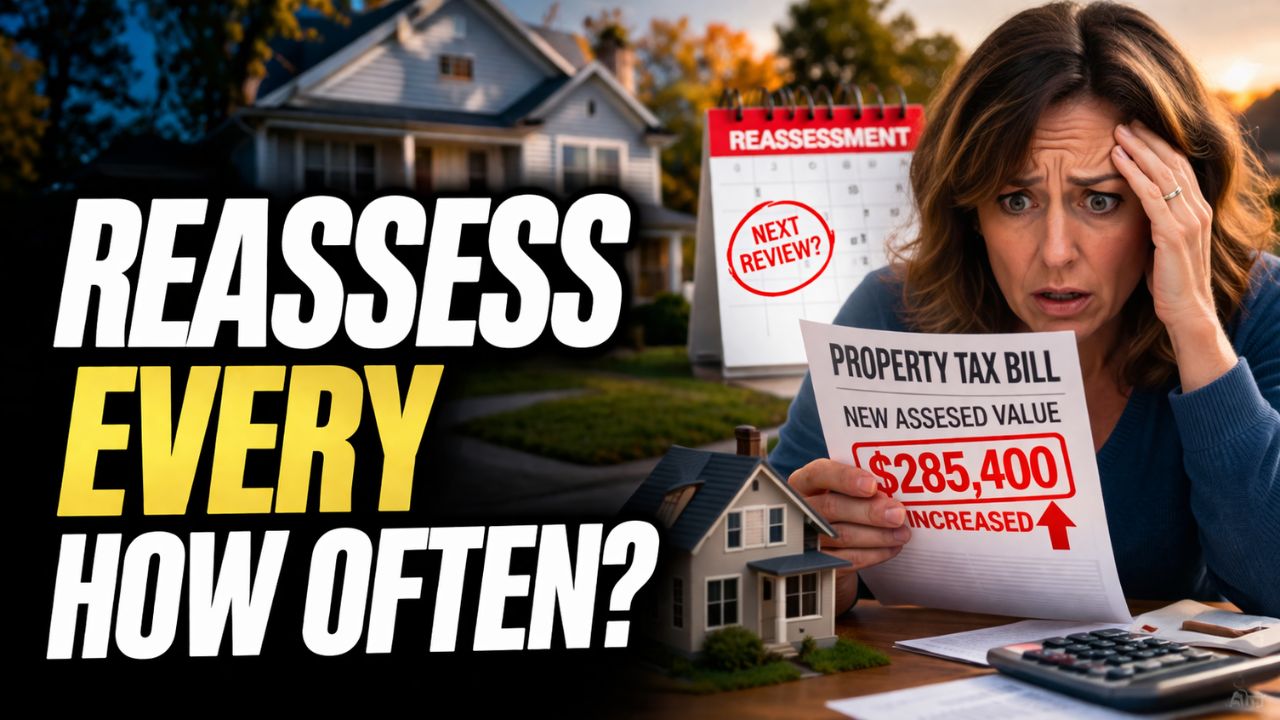
Your property tax bill didn’t just go up by chance.
If you own a home in Cuyahoga County and your latest tax statement felt like a punch to the gut, there’s a specific reason — and a specific schedule behind it. Understanding when and how the county reassesses property values isn’t just useful information. Right now, it could be the difference between overpaying for years and knowing exactly when to fight back.
The numbers involved are not small. The Cuyahoga County Fiscal Office announced proposed results from the state-ordered Sexennial Reappraisal in July 2024, showing an average increase of 32% in home values across the county, ranging from 15% in Hunting Valley to 67% in East Cleveland. Tens of thousands of homeowners opened their mail last year and saw figures they weren’t expecting. Many still don’t fully understand why.
What Happened
As required by state law, every county in Ohio must update property values every three years and conduct a full reappraisal every six years. Cuyahoga County completed its most recent full reappraisal — called a Sexennial Reappraisal — in 2024.
Property revaluations occur in two cycles: the sexennial reappraisal, conducted every six years, and the triennial update, performed every three years between reappraisals.
The last triennial update before this cycle was in 2021. The next triennial update is scheduled for 2027, when the County Fiscal Office will look at recent sales and provide an average increase to the community.
So the short answer: your property is formally reviewed every three years, with a deeper, more intensive full reappraisal every six.
Why This Matters for Homeowners
Most homeowners assume their property taxes are relatively stable from year to year. That assumption is costly.
The sexennial appraisal is much greater in scope than the triennial update — every parcel in Cuyahoga County must be physically viewed by a state-licensed appraiser before the property can be valued. That’s not a desk review. Someone actually walks your property.
Your annual property tax bill is determined by the taxable value of your property multiplied by the tax rate levied by Cuyahoga County, your city, your school district, and your library district. Your taxable value is 35% of market value for real property.
Here’s something most people miss: a higher assessed value does not automatically mean a proportionally higher tax bill. But it often means a higher bill regardless.
Who Is Most Affected
Not every neighborhood felt this equally.
The average value increase across the county was 32.22% for residential property, 8.45% for commercial property, and 8.49% for industrial property. Residents in areas like East Cleveland saw values jump far more sharply than those in wealthier suburbs.
Tax delinquencies skyrocketed in the wake of the 2024 reassessment — a sign that many property owners were caught off guard by the new bills.
Seniors, longtime homeowners on fixed incomes, and residents in lower-income neighborhoods face the sharpest squeeze. When your home’s assessed value climbs 50% but your income doesn’t, the math gets brutal fast.
The Financial Impact Explained
Ohio has a protection mechanism built in — but it only goes so far.
You are protected from unvoted increases in taxes by Ohio legislation known as House Bill 920, passed in 1976. HB 920 reduces your rate as property values in your district increase during triennial reappraisals and updates.
The catch: HB 920 applies only to voted levies. Inside millage — the unvoted portion of your bill — is not subject to that reduction.
Here’s a concrete example of what that can mean in practice. If a home’s assessed value rises to $92,000 following the 2024 reappraisal, the resulting annual bill could be close to $6,900 — an increase of more than $1,600 per year, or roughly $133 more every month, even without any changes to local tax levies.
That’s real money. And it compounds over years if you don’t act.
What You Should Do Now
The window to formally challenge your valuation is open — but it won’t stay open indefinitely.
The Cuyahoga County Board of Revision is now accepting complaints from property owners who want to challenge their property valuations.
Documents you can submit to support your case include a complete appraisal report from the last calendar year, dated photographs of the property showing existing conditions, certified estimates from a contractor for repairs, and a purchase agreement with closing statement.
Consider a homeowner in Garfield Heights whose assessed value jumped 45% but whose home has foundation cracks and an aging roof. With a licensed contractor estimate and recent photos, that homeowner has a legitimate basis to file. Many who file never do — simply because they didn’t know they could.
You can file complaints electronically via the Cuyahoga County Board of Revision portal, by mail, or in person at the county administrative building at 2079 E. 9th Street, Cleveland.
Important Dates and Deadlines
Tax complaints can be filed with the Board of Revision from January through March of 2025 — specifically January 1 through March 31, 2025.
If you missed that window, your next opportunity arrives with the 2027 triennial update. Mark your calendar. That cycle will again trigger a review of assessed values across the county, and property owners will have a fresh shot at contesting figures they believe are inaccurate.
Real estate taxes are billed in arrears — charges payable in 2026 are for tax year 2025. That billing lag trips up many homeowners who assume the bill they receive reflects the current year.
Official Context and Background
Under Ohio State law and Department of Taxation rules, real property is reappraised every six years by state-licensed appraisers. An increase in valuation does not mean property taxes will increase — an appraisal is a professional opinion and estimate of value.
The County Auditor conducts the appraisals as an agent of the State of Ohio Department of Taxation. The Department of Taxation issues an order to initiate reappraisals along with a deadline for completion, to which the Auditor must submit a detailed plan for state approval.
More than $2.4 billion in property tax revenue flows annually from county parcels to schools, libraries, public safety, and local infrastructure. That figure explains why the state takes this process seriously — and why homeowners should too.
Approximately 60% of your tax bill is distributed to your school system. The reassessment isn’t just a county revenue decision. It affects every public institution your family relies on.
Key Takeaways
Cuyahoga County reassesses property on a strict schedule mandated by Ohio law: a full sexennial reappraisal every six years, with a triennial update at the midpoint. The most recent full reappraisal occurred in 2024 and produced the largest average valuation increase in recent memory. The next update comes in 2027.
A higher assessed value does not automatically produce a proportionally higher tax bill, but many homeowners will see meaningful increases regardless. Ohio’s HB 920 offers partial protection — not complete protection.
If your valuation feels wrong, you have the right to challenge it. Documentation matters. Acting within the filing window matters more.
Frequently Asked Questions
How often does Cuyahoga County reassess property values? Every three years. A full physical reappraisal happens every six years. A triennial update — based on recent sales data rather than individual inspections — happens at the three-year midpoint.
Did my home’s value really go up 32%? That was the countywide average for residential property in the 2024 sexennial reappraisal. Individual increases varied widely — some properties rose far more, others less.
Will my tax bill increase by the same percentage as my assessed value? Not necessarily. Ohio’s House Bill 920 reduces effective millage rates on voted levies when values rise. However, unvoted (inside) millage is not protected and can result in higher bills even when HB 920 applies to other portions.
When is the next Cuyahoga County reassessment? The next scheduled event is a triennial update in 2027. The following full sexennial reappraisal would come in 2030.
Where can I get official information about my property valuation? The Cuyahoga County Fiscal Office is the authoritative source. The county website at cuyahogacounty.gov provides valuation notices, tax estimates, and complaint filing information. The Fiscal Office can also be reached at 216-443-7420.
Information in this article reflects data from the Cuyahoga County Fiscal Office, the Ohio Department of Taxation, and official county records as of April 2026. Property owners with specific valuation questions should consult the county directly or seek advice from a licensed real estate attorney or appraiser.