

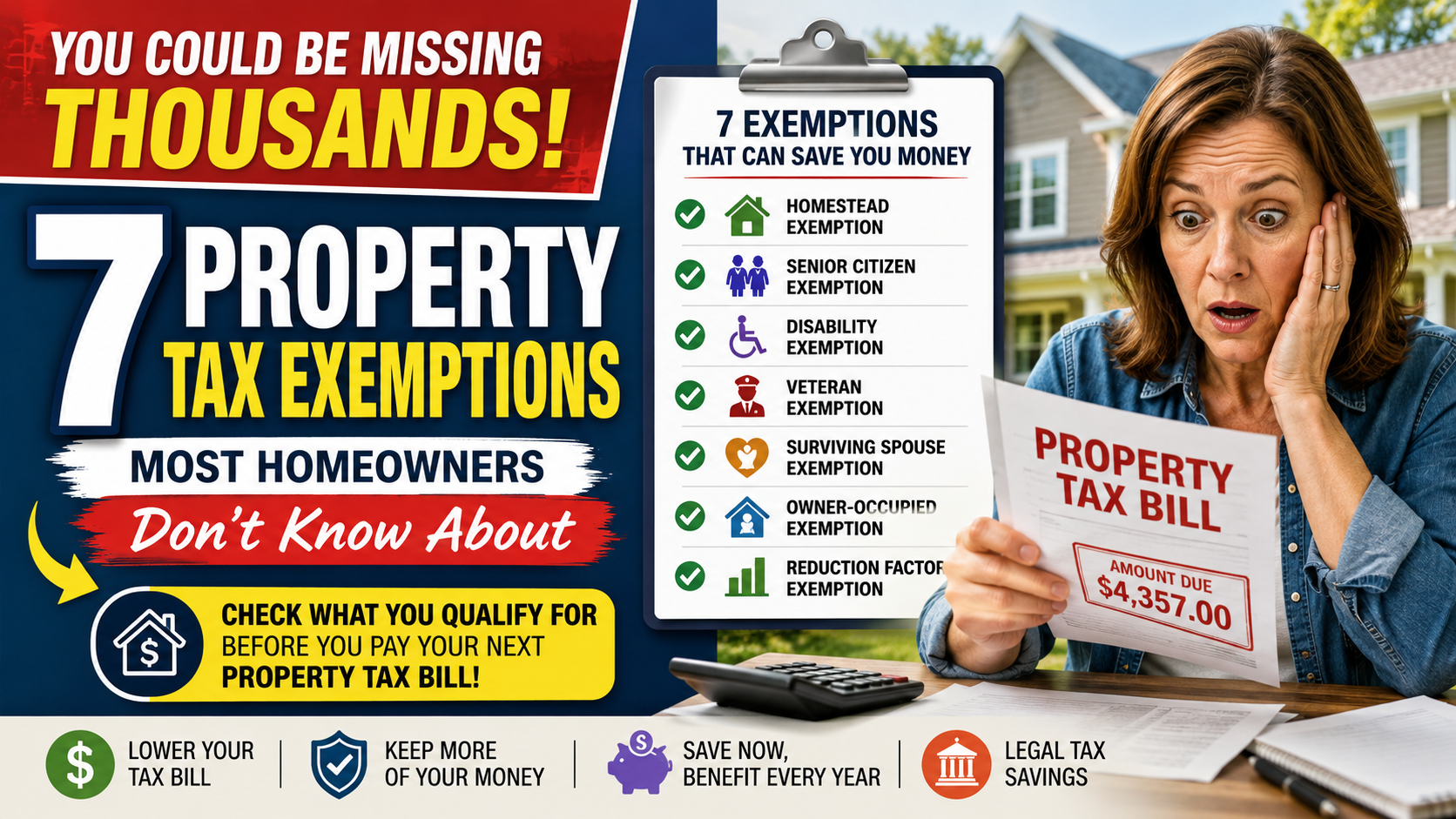
Every year, millions of American homeowners write a check to their county tax office without ever asking a simple question: Do I actually owe this much?
The truth is, most homeowners qualify for at least one property tax exemption — and many qualify for several. But because these programs are rarely advertised, most people never apply. That means thousands of dollars quietly walking out the door, year after year.
Before you pay your next property tax bill, read this guide. You may be leaving serious money on the table.
What Is a Property Tax Exemption?
A property tax exemption is a legal reduction in the assessed value of your home — which directly lowers the amount of tax you owe. Some exemptions knock a flat dollar amount off your bill. Others reduce your assessed value by a percentage. A few can freeze your taxes entirely.
These aren’t loopholes. They’re programs your state and county created specifically to help homeowners like you. They just don’t shout about them.
Here are the seven most commonly missed exemptions in the United States.
1. The Homestead Exemption
Who qualifies: Homeowners who use their property as their primary residence.
This is the big one — and the one most homeowners fail to claim simply because they didn’t know they had to file for it. The homestead exemption reduces the taxable value of your home, which directly lowers your annual tax bill.
In Texas, for example, the standard homestead exemption removes $100,000 from your home’s assessed value before taxes are calculated. In Florida, it can be up to $50,000. Every state structures it differently, but the principle is the same: if this is your home, you’re entitled to a discount.
Important: In most states, you must apply. It does not happen automatically.
Action step: Contact your county assessor’s office or visit their website. Search for “homestead exemption application” along with your county name.
2. Senior Citizen Property Tax Relief
Who qualifies: Homeowners typically age 61–65 and older, depending on the state.
If you’re a senior homeowner, this may be the most valuable exemption available to you. Senior property tax relief programs come in several forms:
- A flat reduction in assessed value
- A percentage discount on your tax bill
- A complete tax freeze at a certain year’s rate
- An income-based circuit breaker that caps what you owe
Many states allow senior homeowners to lock in their property taxes at a set level — meaning your taxes cannot increase even if your home’s value rises. For people on fixed incomes, this protection is enormous.
States with notable senior programs: Washington, Oregon, New Jersey, Illinois, Colorado, and many others.
Action step: Call your county assessor’s office and specifically ask about senior exemptions and tax freeze programs. Bring your ID and proof of age.
3. Disability Exemption
Who qualifies: Homeowners with a qualifying disability, often defined by the state.
If you or your spouse has a permanent disability, you may qualify for a significant reduction in your property taxes. Some states offer a complete exemption for homeowners who are fully disabled. Others offer a partial reduction tied to the severity of the disability.
Many states also extend this exemption to homeowners whose property has been modified to accommodate a disability — ramps, widened doorways, accessible bathrooms — which can further reduce your taxable value.
Documentation typically required: A letter from your doctor or official disability certification from the Social Security Administration.
Action step: Ask your county assessor’s office for their disability exemption form and eligibility requirements. Don’t assume you don’t qualify — apply and let them decide.
4. Veteran and Military Exemption
Who qualifies: Veterans, active-duty military, surviving spouses of veterans.
The United States offers some of the most generous property tax benefits in the world for veterans — and yet many veterans never claim them.
Depending on your state and your level of disability rating from the VA, you could qualify for:
- A partial exemption on your home’s assessed value
- A 100% property tax exemption if you have a full disability rating
- A surviving spouse exemption that continues after a veteran’s death
- An active-duty exemption during deployment
Texas, Florida, California, and Virginia are among the states with the strongest veteran property tax programs.
Action step: Contact your county assessor’s office and your state’s Department of Veterans Affairs. Have your DD-214 and your VA disability rating letter ready.
5. Agricultural and Land Use Exemption
Who qualifies: Homeowners with land used for farming, ranching, forestry, or conservation.
If your property includes acreage that you use — or that qualifies — for agricultural purposes, you may be taxed at a significantly lower agricultural rate rather than at the full residential or commercial rate.
This exemption applies to far more homeowners than most people realize. You don’t need to run a commercial farm. In many states, keeping a small vegetable garden, grazing a few animals, or maintaining an orchard can qualify your land for agricultural designation.
Conservation easements — agreements to preserve land from development — also often qualify for significant tax reductions.
Action step: If your property has any acreage at all, ask your county assessor whether any portion qualifies for an agricultural or conservation designation.
6. Owner-Occupied and Primary Residence Exemption
Who qualifies: Homeowners who live in the home they own (as opposed to renting it out).
Many counties and states assess owner-occupied homes at a lower rate than investment properties or second homes. If your county has such a program and you’ve never filed for it, you may be paying taxes at the non-owner rate — which is almost always higher.
This is different from the homestead exemption (though some states combine them). The owner-occupied distinction simply confirms: this person lives here. And that often unlocks a better tax rate automatically.
Action step: Ask your county assessor whether your home is currently classified as owner-occupied. If it isn’t, ask how to correct that.
7. Circuit Breaker or Income-Based Tax Relief
Who qualifies: Low- to moderate-income homeowners, often with income below a set threshold.
This is perhaps the least-known exemption on this list — and one of the most valuable for homeowners on fixed or limited incomes.
A property tax “circuit breaker” works exactly like an electrical circuit breaker: when your property tax burden becomes too high relative to your income, the program kicks in and caps what you owe. Some states issue the excess as a direct credit or rebate.
For a retired homeowner whose income has dropped significantly, this program can mean hundreds or even thousands of dollars back every year.
States with circuit breaker programs include: Maine, Michigan, Minnesota, Arizona, and many others. Income thresholds and benefit levels vary widely.
Action step: Search “[your state] property tax circuit breaker” or ask your county assessor whether an income-based relief program is available.
How to Find Out What You Qualify For
You don’t need a lawyer or a tax professional to start this process. Here’s a simple action plan:
Step 1: Visit your county assessor’s or auditor’s website. Most have a dedicated exemptions page.
Step 2: Call their office directly. Tell them your address and ask: “What exemptions is this property currently receiving, and what other programs might I qualify for?”
Step 3: Ask about deadlines. Most exemptions require annual or one-time applications, and many have filing windows you can’t miss.
Step 4: Gather your documentation. Common documents include proof of age, proof of residency, disability certification, or VA rating letters.
Step 5: Apply. The form is usually simple. The savings can be significant.
One Final Thought
The most expensive mistake a homeowner can make isn’t missing a payment — it’s overpaying for years without realizing it.
These programs exist. They were created for homeowners exactly like you. The only thing standing between you and the savings is a phone call or a short application.
Check what you qualify for before your next tax bill arrives.
Note: Property tax exemption programs vary by state and county. Eligibility requirements, exemption amounts, and application deadlines differ by location. Contact your local county assessor’s office for the specific rules that apply to your property.